CMC Grades Compared: Detergent, Paper, Food, Battery & More
Seven CMC grades compared by DS, purity and viscosity, from detergent and paper to food, battery and drilling PAC, plus a path to the right grade.
Written byGuo Jianping · Head of Technology
Technical reviewZhou Zhi · Head of Quality Control
Published · Updated · 6 min read
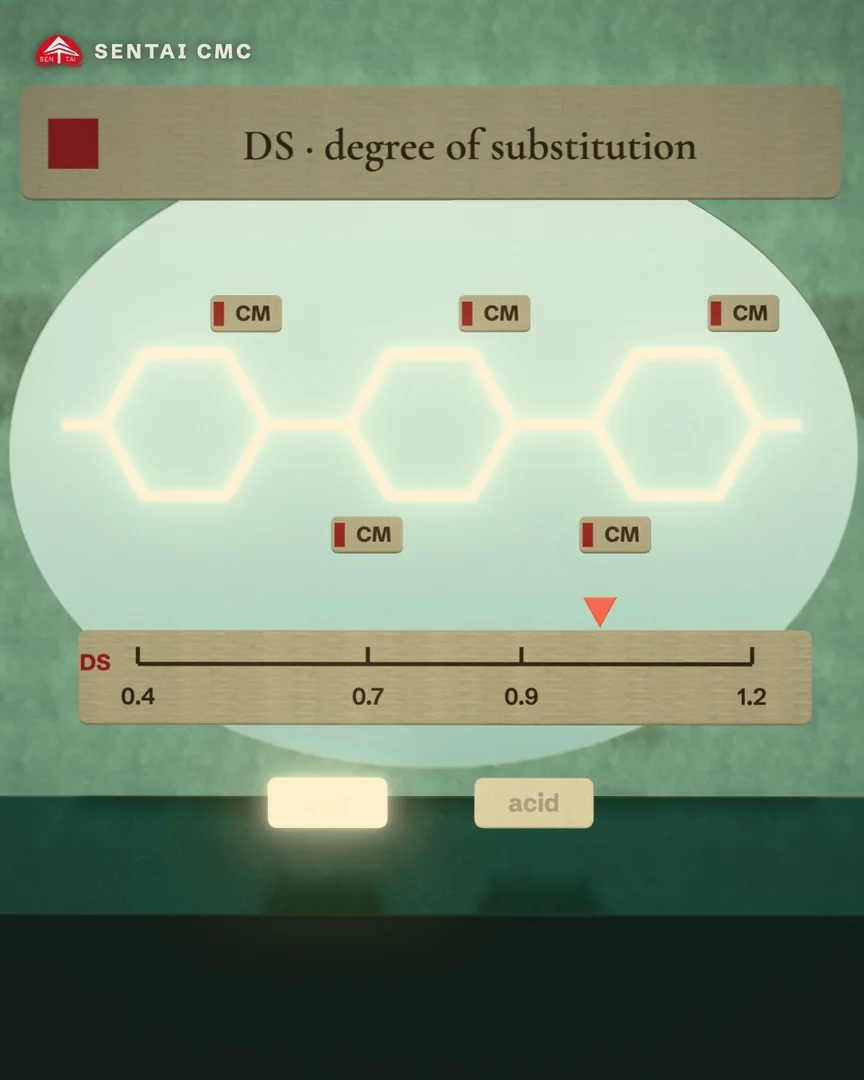
CMC grades differ in three numbers: degree of substitution (DS), purity and viscosity. A detergent-powder grade can be 55–70 % pure, while food and battery grades are refined to at least 99.5 %. The quickest way to the right grade is a decision path: start from your application, go to the matching product family, then pick the grade by DS and viscosity.
This is Part 4 of Sentai's CMC glossary series, after Part 3 on how to read a CMC spec sheet. Every figure below comes from the grade tables of Sentai's CMC, PAC and CMS product range.
In one sentence: choose a CMC grade by what your system can tolerate and what it needs to control, not by the name on the bag.
Watch the 50-second film
The paper-cut film compares seven grades in about 50 seconds. It is narrated in English, with Afrikaans and Japanese subtitles on YouTube.
- Watch on YouTube
- Watch on LinkedIn
- Watch on Instagram
- Part 1 film: CMC names compared
- Part 2 film: what CMC does
- Part 3 film: how to read a spec sheet
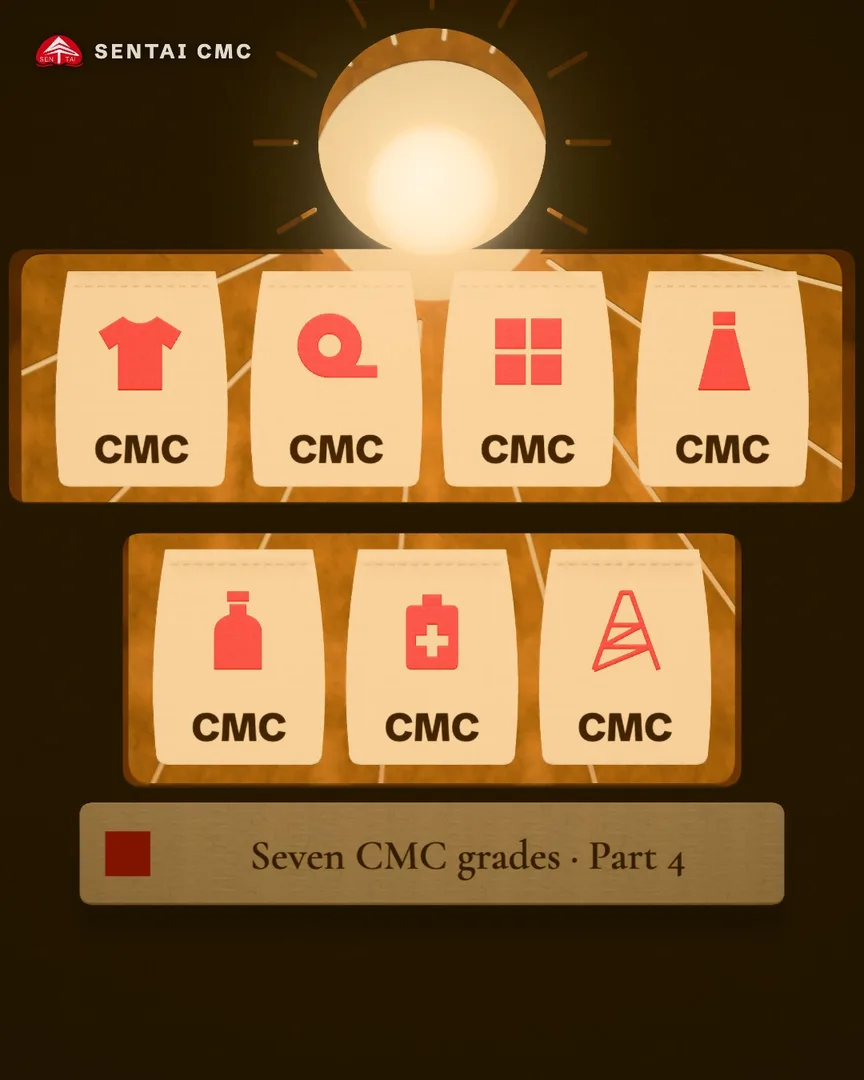
Seven grades at a glance
- Detergent-grade CMC for laundry powder: DS 0.4–0.6; purity 55–70 %; 5–600 mPa·s at 2 %
- Paper-grade CMC: DS 0.7–1.0; 7–600 mPa·s at 2 %
- Ceramic-grade CMC for glazes: DS ≥ 0.95; purity ≥ 95 %; 400–700 mPa·s at 1 %
- Toothpaste-grade CMC: DS ≥ 0.95; purity ≥ 98 %; 200–400 mPa·s at 1 %
- Food-grade CMC, E466: purity ≥ 99.5 %; Type 6 DS 0.75–0.90; Type 9 DS ≥ 0.90
- Battery-grade CMC: purity ≥ 99.5 %; chloride ≤ 0.50 %; gel particles ≤ 3–5 per 4 cm²
- Oil-drilling PAC: DS ≥ 0.9; filtrate loss ≤ 16 mL; apparent viscosity ≤ 40 mPa·s (PAC-LV) or ≥ 50 mPa·s (PAC-HV)
The decision path: application, family, grade
- Name the application. It decides the family: a laundry powder points to detergent grade, a glaze to ceramic grade, an anode slurry to battery grade.
- Check how much by-product salt the system can carry. A detergent powder tolerates plenty; food, toothpaste and batteries need refined grades.
- Check what the system contains. The more salt, acid, fluoride or hard water, the higher the DS you need.
- Choose viscosity last, and compare values only at the same concentration, temperature and viscometer.
- Test a sample in your own formula before you commit to a grade.
The guide to DS, viscosity and purity explains how the three numbers interact. The sections below apply the path to seven applications.
1. Detergent powder
Laundry powders use technical-grade CMC, with DS 0.4–0.6 and 55–70 % purity. The rest is sodium chloride and sodium glycolate left from the reaction. A powder already contains sodium sulfate, sodium carbonate and other salts, so these by-products do no harm.
In Sentai's range, ST-20 runs at 5–40 mPa·s, ST-50 at 10–100 mPa·s and ST-100 at 100–600 mPa·s, all as a 2 % solution. Compare offers on active content: 1 % of a 60 % grade delivers only about 0.6 % sodium CMC.
Liquid detergents are different. They use high-purity grades of 96 % or more, mainly to thicken. ST-300 runs at 2,500–4,500 mPa·s and ST-500 at 4,500–5,500 mPa·s, both as a 1 % solution.
2. Paper
Paper grades usually sit at DS 0.7–1.0, and viscosity decides the rest. Sentai's PC series spans 7–600 mPa·s as a 2 % solution.
Blade coating runs at very high shear and often at 60–70 % solids, so low-viscosity grades of about 7–50 mPa·s are the norm. They retain water without driving up high-shear viscosity. Size-press grades are chosen together with the liquor solids: a higher molecular weight gives a stronger film but limits the solids you can apply.
3. Ceramic glazes and tile bodies
Glazes contain soluble salts that screen the charge on CMC and reduce its viscosity. Higher-DS, higher-purity grades keep a glaze more stable: C-1001 (DS ≥ 1.0) and C-1002 (DS ≥ 0.95), both at purity ≥ 95 % and 400–700 mPa·s as a 1 % solution.
Tile bodies need less, so lower-DS grades such as C-0664 (DS ≥ 0.6, purity ≥ 60 %) are cost-effective there. Screen-printing glazes use a low-viscosity, high-DS grade such as 9L, at 30–50 mPa·s as a 1 % solution.
4. Toothpaste
Salts, fluoride and pyrophosphate compete for water and screen the charge on CMC, which can let liquid separate from the paste. High-DS grades hold up better against them. IH9 (DS ≥ 0.95) and IH10 (DS ≥ 1.0) are both at purity ≥ 98 % and 200–400 mPa·s as a 1 % solution.
For the highest purity there is 500T, refined to ≥ 99.5 % at 400–700 mPa·s.
5. Food grade (E466)
Food-grade CMC, additive number E466, is purified to at least 99.5 % on a dry basis, with chloride of 0.5 % or less. Sentai food grades are specified to China's national standard GB 1886.232-2016.
Type 6 (DS 0.75–0.90) is the economical thickener for neutral foods such as ice cream and sauces; FH6A runs at 200–500 mPa·s as a 1 % solution. Type 9 (DS ≥ 0.90) stays charged and soluble at low pH, so it stabilises milk protein in acidified milk drinks at about pH 3.8–4.6. FH9A is its 200–500 mPa·s counterpart, and FL10A goes further, to DS ≥ 1.0.
6. Battery grade
Battery-grade CMC for lithium-ion anodes needs the same purity of at least 99.5 %. Chloride is held to 0.50 % or less, because it can corrode the copper current collector. Gels are counted too, per 4 cm² of film: on the coater they cause pinholes, streaks and blinded slurry filters. The guide to battery-grade CMC explains each specification.
Sentai's ST series is then chosen by viscosity, always as a 1 % solution. ST-1 and ST-2, at 20–1,500 mPa·s, have the lowest gel count: ≤ 3 per 4 cm². ST-3 and ST-4, at 1,500–2,600 mPa·s, are the workhorse range for graphite anodes. ST-5 (2,600–3,500 mPa·s) and ST-EH (≥ 5,000 mPa·s) thicken most at the lowest addition rate, for silicon-carbon and thin-electrode designs.
7. Drilling fluids (PAC)
Water-based drilling muds use polyanionic cellulose (PAC), a sodium carboxymethyl cellulose with a DS of 0.9 or more. The deciding number is filtrate loss, not purity: 16 mL or less for Sentai PAC grades, tested to China's GB/T 5005. The low-temperature API test applies 100 psi across filter paper for 30 minutes.
PAC-LV controls filtrate with little added viscosity, at an apparent viscosity of 40 mPa·s or less. PAC-HV also builds viscosity, at 50 mPa·s or more.
Families the film does not cover
Sentai makes six more families, each with its own grade table:
- Instant CMC: dissolves without lumps; DS ≥ 0.95, purity ≥ 97 %
- Coating-grade CMC: emulsion paints and wall putty
- Textile printing and dyeing CMC: warp sizing and printing pastes
- Mining-grade CMC: pellet binding and flotation
- General industrial CMC: adhesives and building materials
- Sodium carboxymethyl starch (CMS): a cost-effective starch ether
Next step
Open the full CMC, PAC and CMS range to compare each family's grade table side by side.
If you are not sure where your system sits on the path, ask for a free sample. Tell us the application, what the system contains and your target viscosity, and we will propose a grade. Samples of 100–300 g are free.
FAQ
What is the difference between technical and refined CMC?+
Technical grades keep the sodium chloride and sodium glycolate left from the reaction and are about 55–70 % pure, which a salt-rich detergent powder tolerates. Refined grades are washed to remove those by-products and reach 96–99.5 % or more, for liquid detergents, toothpaste, food and batteries.
Can detergent-grade CMC be used in food?+
No. Food use needs a grade made and tested to a food-additive specification, such as the JECFA specification for E466 or China's GB 1886.232-2016. These require at least 99.5 % purity on a dry basis, plus limits on chloride, heavy metals and microbes, which a 55–70 % detergent grade cannot meet.
Why is battery-grade CMC so strict?+
Residual chloride can corrode the copper current collector of a lithium-ion anode, and undissolved gels cause pinholes, streaks and blinded filters on the coater. That is why battery grades specify chloride (≤ 0.50 %) and a gel count per 4 cm² of film, as well as a purity of at least 99.5 %.
Is PAC the same as CMC?+
PAC, or polyanionic cellulose, is a high-DS sodium carboxymethyl cellulose made for water-based drilling fluids. Chemically it belongs to the CMC family, but it is sold and specified separately: buyers judge it on filtrate loss and apparent viscosity in a test mud, not on purity.
Why can two CMC grades with the same viscosity behave differently?+
Viscosity says little about DS or purity. Two grades at 400 mPa·s can differ in salt and acid tolerance because of DS, and in active content because of purity. Concentration matters too: a figure at 2 % is not comparable with one at 1 %. Compare all three numbers, then test.
Sources
- JECFA, Sodium carboxymethyl cellulose, Compendium of Food Additive Specifications, Monograph 11 (2011)
- 21 CFR 182.1745 — Sodium carboxymethylcellulose (GRAS), US Electronic Code of Federal Regulations
- ASTM D1439 — Standard Test Methods for Sodium Carboxymethylcellulose
- GB/T 5005-2010 — Specifications of drilling fluid materials (standard listing)
- Du et al., Influence of molecular weight and degree of substitution of carboxymethylcellulose on the stability of acidified milk drinks, Food Hydrocolloids 23 (2009)
- Lee et al., Effect of Carboxymethyl Cellulose on Aqueous Processing of Natural Graphite Negative Electrodes, Journal of The Electrochemical Society 152 (2005)
Guo Jianping · 郭建平
Head of Technology
- 28 years in CMC R&D and production
- 10 years at Ashland's Jiangmen CMC plant
Technical review: Zhou Zhi · Head of Quality Control
Meet the team