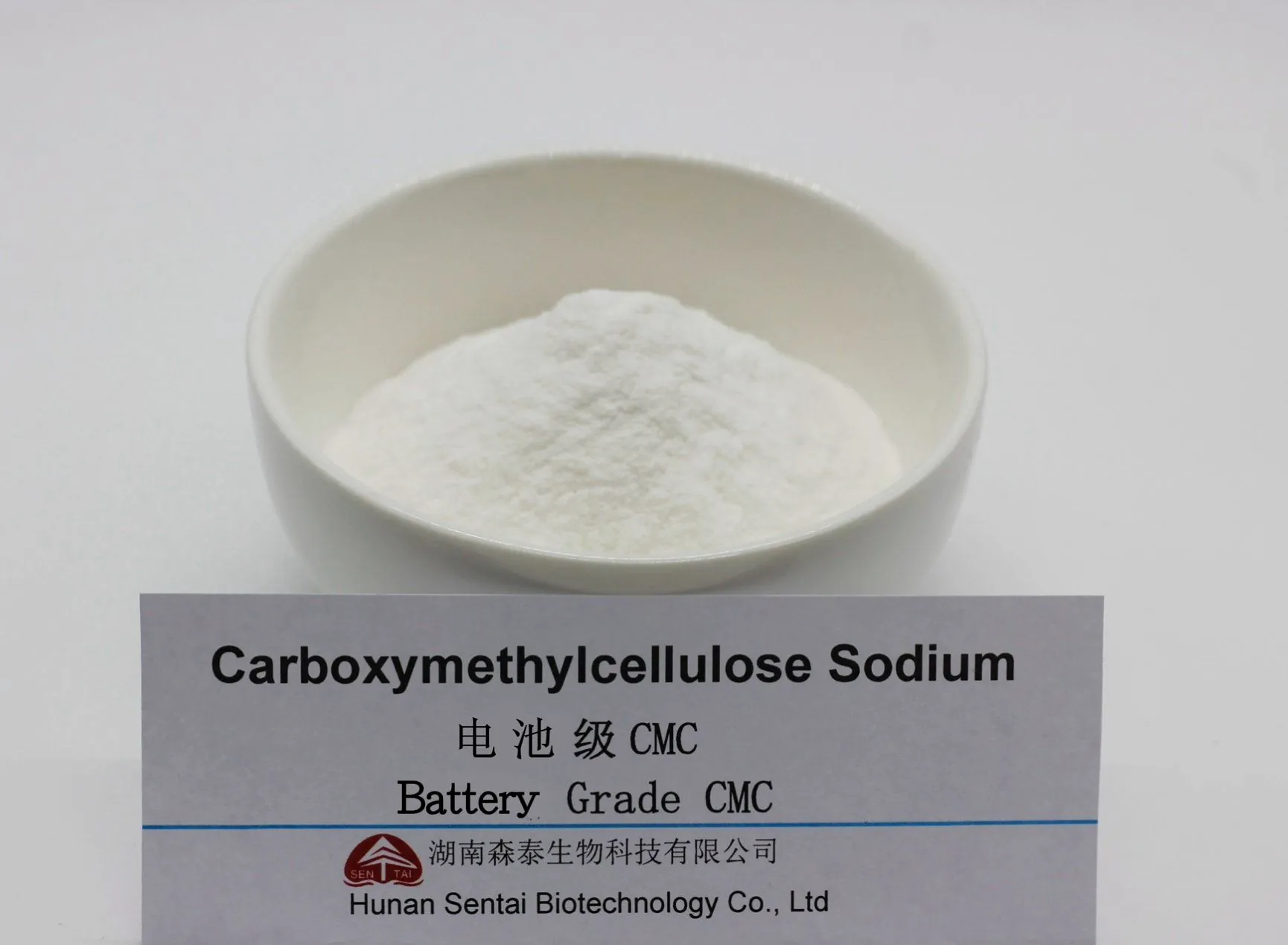

Type 6 vs Type 9 Food-Grade CMC: Stabilising Acidified Milk Drinks, Ice Cream and Sauces
How DS separates Type 6 and Type 9 cellulose gum (E466), how CMC stabilises casein in acidified milk drinks at pH 3.8–4.6, and the GB 1886.232-2016 and JECFA limits food-grade CMC must meet.
Sentai Applications Lab · · 7 min read
Type 6 and Type 9 food-grade CMC are both cellulose gum (sodium carboxymethyl cellulose, INS 466 / E466); the type number signals the degree of substitution. Type 6 (DS 0.75–0.90) is the economical thickener for neutral-pH foods such as ice cream, sauces and bakery fillings. Type 9 (DS ≥ 0.90) stays charged and soluble at low pH and in salt, which is why it is the grade used to stabilise milk protein in acidified milk drinks at a pH of about 3.8–4.6.
What the type number means
Food CMC grades are commonly named by viscosity class and DS type. In Sentai's range, FL and FM are low- and medium-viscosity grades measured in 2 % solution, and FH and FVH are high- and very-high-viscosity grades measured in 1 % solution. The digit that follows shows the DS type, and FL10A is a high-DS grade (DS ≥ 1.0) for the most demanding acidic systems.
| Viscosity class | Type 6 grade (DS 0.75–0.90) | Type 9 grade (DS ≥ 0.90) |
|---|---|---|
| Low, 2 % solution | FL6A: 25–400 mPa·s | FL9A: 25–400 mPa·s |
| Medium, 2 % solution | FM6A: 400–2,000 mPa·s | FM9A: 400–2,000 mPa·s |
| High, 1 % solution | FH6A: 200–500 mPa·s | FH9A: 200–500 mPa·s |
| Very high, 1 % solution | FVH6A-1: 500–2,000 mPa·s | FVH9A-1: 500–2,000 mPa·s |
| Very high, 1 % solution | FVH6A-2: 2,000–5,000 mPa·s | FVH9A-2: 2,000–4,000 mPa·s |
| Ultra high, 1 % solution | FVH6A-3: ≥ 5,000 mPa·s | FVH9A-3: ≥ 4,000 mPa·s |
Why acidified milk drinks need CMC
At neutral pH, casein micelles are stabilised by a negatively charged, hairy outer layer of κ-casein. When milk is acidified towards the isoelectric point of casein, around pH 4.6, that charge is neutralised, the hairy layer collapses and the micelles aggregate. Without a stabiliser, a drinking yoghurt or acidified milk drink at pH 3.8–4.6 sediments, separates whey and feels sandy in the mouth.
Below its isoelectric point casein carries a net positive charge, while CMC's carboxyl groups, with an apparent pKa of roughly 4 to 4.5, still carry a substantial negative charge. CMC chains therefore adsorb onto the protein particles: part of each chain anchors to the surface, and the rest extends into the serum as loops and tails. The particles are then held apart by electrostatic repulsion between their new negative coats and by steric hindrance from the extended chains, which is known as electrosteric stabilisation. Non-adsorbed CMC adds serum viscosity, which slows any remaining sedimentation.
A higher DS means more charge at low pH and stronger adsorption, which is why Type 9 grades are used. The dose has an optimum: with too little CMC one chain can bridge two particles and flocculate them, while a large excess of free CMC can cause depletion flocculation. Published studies have shown that both the molecular weight and the DS of CMC influence the stability of acidified milk drinks, so qualify grade and dose together.
Process tips for acidified milk drinks
- Dry-blend the CMC with part of the sugar, typically at least five parts sugar to one part CMC, and disperse it in water under agitation.
- Hydrate the CMC completely before it meets the milk, because undissolved particles cannot protect protein.
- Combine the CMC solution with the milk at neutral pH, so the stabiliser is in place before the pH passes through casein's isoelectric point.
- Cool the mix and add dilute acid slowly under high shear to the target pH, typically 3.8–4.2.
- Homogenise and heat-treat, then check stability by centrifugation and by storage at the intended temperature.
Typical CMC levels in acidified milk drinks are in the region of 0.3–0.5 %, depending on protein content, viscosity target and heat treatment. Treat these as starting values for your own trials.
Ice cream, sauces and other foods
In ice cream and frozen desserts, CMC binds water, builds mix viscosity and slows the growth of ice crystals when the product is warmed and refrozen during distribution. It is usually part of a stabiliser blend with gums such as guar or locust bean gum, plus a little carrageenan to prevent whey separation in the mix, and the total stabiliser typically falls around 0.2–0.5 % of the mix. High- and very-high-viscosity Type 6 grades such as FH6A and FVH6A-1 are the usual starting point.
Neutral sauces, soups, bakery fillings and noodles generally need only Type 6. Dressings, fruit-based sauces and high-salt condiments benefit from Type 9 or FL10A, because acid and salt suppress the charge of lower-DS CMC and cause viscosity loss or haze. Sentai's general food dosage guideline is 0.1–0.5 % of the formulation as a typical starting point, to be optimised in your process.
GB 1886.232-2016 and JECFA requirements
China's national food-safety standard GB 1886.232-2016 and the JECFA specification for sodium carboxymethyl cellulose set the identity and purity limits for food use. Sentai food grades are specified against GB 1886.232-2016 and carry additional microbiological release limits.
| Parameter | GB 1886.232-2016 | JECFA (2011) | Sentai food-grade release |
|---|---|---|---|
| Sodium CMC content, dry basis | ≥ 99.5 % | ≥ 99.5 % | ≥ 99.5 % |
| Degree of substitution | 0.20–1.50 | 0.20–1.50 | Type 6: 0.75–0.90; Type 9: ≥ 0.90; FL10A: ≥ 1.0 |
| pH, 1 % solution | 6.0–8.5 | 6.0–8.5 | 6.5–8.5 |
| Loss on drying | ≤ 8.0 % | ≤ 12 % | ≤ 8.0 % |
| Chloride (as NaCl) | ≤ 0.5 % | ≤ 0.5 % | ≤ 0.5 % |
| Sodium glycolate | ≤ 0.4 % | ≤ 0.4 % | ≤ 0.4 % |
| Sodium | ≤ 12.4 % | ≤ 12.4 % | — |
| Arsenic (As) | ≤ 2.0 mg/kg | — | ≤ 2.0 mg/kg |
| Lead (Pb) | ≤ 2.0 mg/kg | ≤ 2 mg/kg | ≤ 2.0 mg/kg |
| Viscosity | ≥ 5.0 mPa·s at 2 %; measured at 1 % when the 2 % value is ≥ 2,000 mPa·s | Specified by the article of commerce | 25 to above 5,000 mPa·s, by grade |
| Microbiology | — | — | Total plate count ≤ 500 cfu/g; moulds and yeasts ≤ 100 cfu/g; E. coli, Salmonella and S. aureus not detected |
How to choose
- Neutral pH and little salt: Type 6, choosing the viscosity class from the body you need.
- pH below about 5, or high salt: Type 9; for the lowest pH or highest salt, FL10A (DS ≥ 1.0).
- Acidified milk drinks: start with FH9A, the grade Sentai positions for this application, and optimise the dose for your protein level.
- High-solids products that need little added viscosity, such as syrups or fillings: FL or FM grades measured at 2 %.
- Always confirm stability over the full shelf life at the intended storage temperature.
How Sentai can help
Sentai's food-grade CMC family offers 13 grades in Type 6, Type 9 and high-DS versions, all with ≥ 99.5 % purity and released against GB 1886.232-2016. Send your formulation, pH and process conditions and the applications team will suggest a starting grade. When you request a quotation, tell us your destination market and any certification requirement, such as Halal or Kosher, so that the export team can confirm the documentation available for the grade you select.
FAQ
What is the difference between Type 6 and Type 9 food-grade CMC?+
The type number reflects the degree of substitution. Type 6 (DS 0.75–0.90) is the economical thickener for neutral-pH foods. Type 9 (DS ≥ 0.90) carries more carboxymethyl groups, so it stays soluble and protective at low pH and in salt, as acidified milk drinks require.
Why is CMC used in acidified milk drinks?+
When milk is acidified towards pH 4.6, casein loses its charge and aggregates. CMC adsorbs onto the protein particles and keeps them apart by electrostatic and steric repulsion, preventing sedimentation and whey separation at a pH of about 3.8–4.6.
Is CMC the same as cellulose gum and E466?+
Yes. Sodium carboxymethyl cellulose is known as cellulose gum, with the number INS 466 in the Codex system and E466 in the European Union. Food grades must meet purity specifications such as those of JECFA and China's GB 1886.232-2016.
What does GB 1886.232-2016 require for food-grade CMC?+
GB 1886.232-2016 requires a sodium carboxymethyl cellulose content of at least 99.5 %, DS 0.20–1.50, pH 6.0–8.5, loss on drying ≤ 8.0 %, chloride ≤ 0.5 % as NaCl, sodium glycolate ≤ 0.4 %, sodium ≤ 12.4 %, and arsenic and lead each ≤ 2.0 mg/kg.
How much CMC is used in ice cream?+
CMC is typically part of a stabiliser blend that totals around 0.2–0.5 % of the ice-cream mix, often with guar or locust bean gum and a little carrageenan. A high-viscosity Type 6 grade is the usual starting point.
Sources
- FAO JECFA Monographs 11 (2011) — Sodium carboxymethyl cellulose specification
- GB 1886.232-2016 — Food additive sodium carboxymethyl cellulose (standard listing)
- EFSA (2018) — Re-evaluation of celluloses E 460(i)–E 469 as food additives
- Du et al., Influence of molecular weight and degree of substitution of carboxymethylcellulose on the stability of acidified milk drinks, Food Hydrocolloids 23 (2009)
- Casein — Wikipedia