
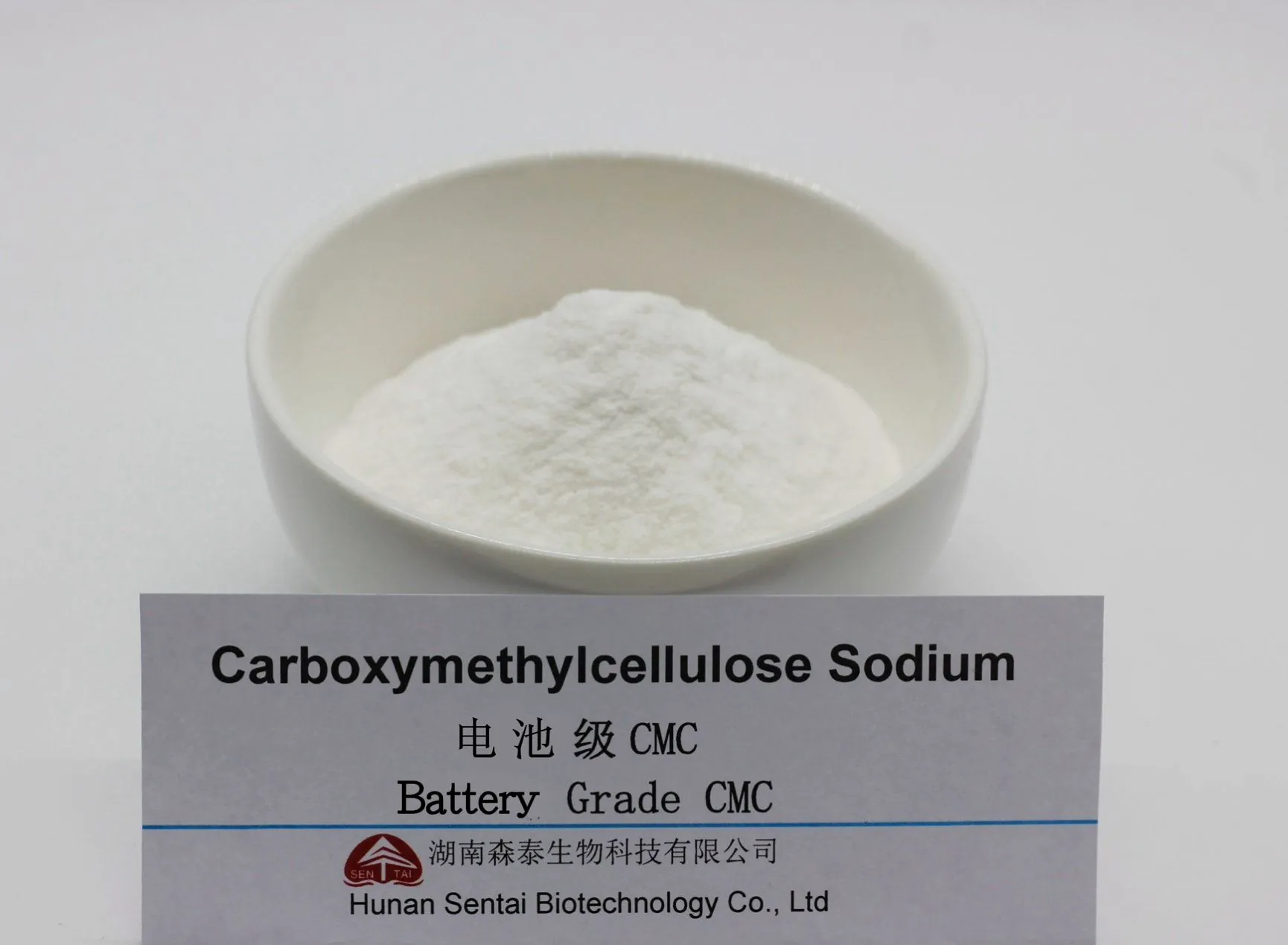
CMC · Lithium-ion batteries
Battery-Grade CMC
≥ 99.5 % purity anode binder & dispersant for graphite and silicon-carbon electrodes.
- Purity
- ≥ 99.5 %
- pH (1 % solution)
- 6.0 – 8.5
- Loss on drying
- ≤ 10.0 %
- Chloride (as NaCl)
- ≤ 0.50 %
- Particle size
- ≥ 85 % through 200 mesh (75 µm)
- Compatible binders
- SBR · PAA
Common to all grades
[01]Overview
Sentai ST-series battery-grade sodium carboxymethyl cellulose is the water-based thickener and dispersant of choice for lithium-ion anode slurries. Refined to ≥ 99.5 % purity with chloride held at ≤ 0.50 % and gel particles counted per 4 cm², it keeps graphite and conductive carbon uniformly suspended, stabilises slurry rheology for coating, and works with SBR or PAA binders to build electrode peel strength.
- Typical dosage
- 0.8 – 1.5 % of electrode solids
- HS code
- 3912.31
- CAS No.
- 9004-32-4
What it does
- 01Disperses graphite / Si-C active material and conductive carbon
- 02Thickens and stabilises the slurry — prevents settling during storage and coating
- 03Forms a film with SBR or PAA to raise electrode peel strength and cohesion
- 04Low chloride and low insolubles protect copper foil and coating quality
Published lab benchmark — Sentai ST4 vs. imported and domestic CMC
500 mL vacuum filtration time
s
- Imported A12.8
- Imported B9.4
- Imported C6.6
- Imported D9.1
- Domestic Ano flow
- Domestic B8.2
- Sentai ST46.1●
Gel particles
/4 cm²
- Imported A7
- Imported B3●
- Imported C4
- Imported D6
- Domestic A24
- Domestic B3●
- Sentai ST43●
Insolubles (90 °C)
%
- Imported A0.13●
- Imported B0.56
- Imported C0.32
- Imported D0.53
- Domestic A0.48
- Domestic B0.34
- Sentai ST40.15
Chloride (Cl⁻)
%
- Imported A0.4
- Imported B0.51
- Imported C0.46
- Imported D0.3●
- Domestic A1.52
- Domestic B0.56
- Sentai ST40.5
Sentai laboratory comparison as published by the company (competitor samples anonymised). Lower is better. Verify against your own incoming-inspection method.
[02]Grades & specifications
6 grades
Values are specification limits. Typical values and test methods are on the full TDS (Customer Portal or on request).
| Grade | Viscosity · mPa·s | DS | Purity % | pH | Moisture % | NaCl % | Gel particles | Fibre / insolubles | Spec sheet |
|---|---|---|---|---|---|---|---|---|---|
| ST-1Low viscosity · dispersant | 20–800 @1% | 0.8–1 | ≥ 99.5 | 6–8.5 | ≤ 10 | ≤ 0.5 | ≤ 3 / 4 cm² | Class A | Spec sheet → |
| ST-2Low–mid viscosity | 800–1500 @1% | 0.8–1 | ≥ 99.5 | 6–8.5 | ≤ 10 | ≤ 0.5 | ≤ 3 / 4 cm² | Class A | Spec sheet → |
| ST-3Mid viscosity · graphite anodes | 1500–2000 @1% | 0.8–1 | ≥ 99.5 | 6–8.5 | ≤ 10 | ≤ 0.5 | ≤ 5 / 4 cm² | Class A | Spec sheet → |
| ST-4Mid–high viscosity | 2000–2600 @1% | 0.8–1 | ≥ 99.5 | 6–8.5 | ≤ 10 | ≤ 0.5 | ≤ 5 / 4 cm² | Class A | Spec sheet → |
| ST-5High viscosity | 2600–3500 @1% | 0.8–1 | ≥ 99.5 | 6–8.5 | ≤ 10 | ≤ 0.5 | ≤ 5 / 4 cm² | Class B | Spec sheet → |
| ST-EHExtra-high viscosity · Si-C anodes | ≥ 5000 @1% | 0.7–0.9 | ≥ 99.5 | 6–8.5 | ≤ 10 | ≤ 0.5 | ≤ 5 / 4 cm² | Class B | Spec sheet → |
Common to all grades
- Purity
- ≥ 99.5 %
- pH (1 % solution)
- 6.0 – 8.5
- Loss on drying
- ≤ 10.0 %
- Chloride (as NaCl)
- ≤ 0.50 %
- Particle size
- ≥ 85 % through 200 mesh (75 µm)
- Compatible binders
- SBR · PAA
Viscosity windows
Brookfield viscosity, mPa·s, 25 °C — log scale
Grade map
Each bubble is a grade: degree of substitution on the horizontal axis, minimum purity on the vertical, bubble size by viscosity.
Product photos
The real product.
[03]Applications
Lithium-ion batteries
- Graphite anodes for EV, ESS and consumer cells
- Silicon-carbon composite anodes (with PAA or SBR)
- LFP / LTO water-based electrode systems
- Separator coating slurries (ceramic-coated separators)
[04]Selection guide
Which grade?
- ST-1 / ST-2 — low viscosity, lowest gel count (≤ 3 / 4 cm²): high-solids slurries and fine-pitch coating.
- ST-3 / ST-4 — mid viscosity, the workhorse range for graphite anodes at 45–52 % solids.
- ST-5 and Extra-High — maximum thickening at the lowest addition rate; silicon-carbon and thin-electrode designs.
[05]Packaging & supply
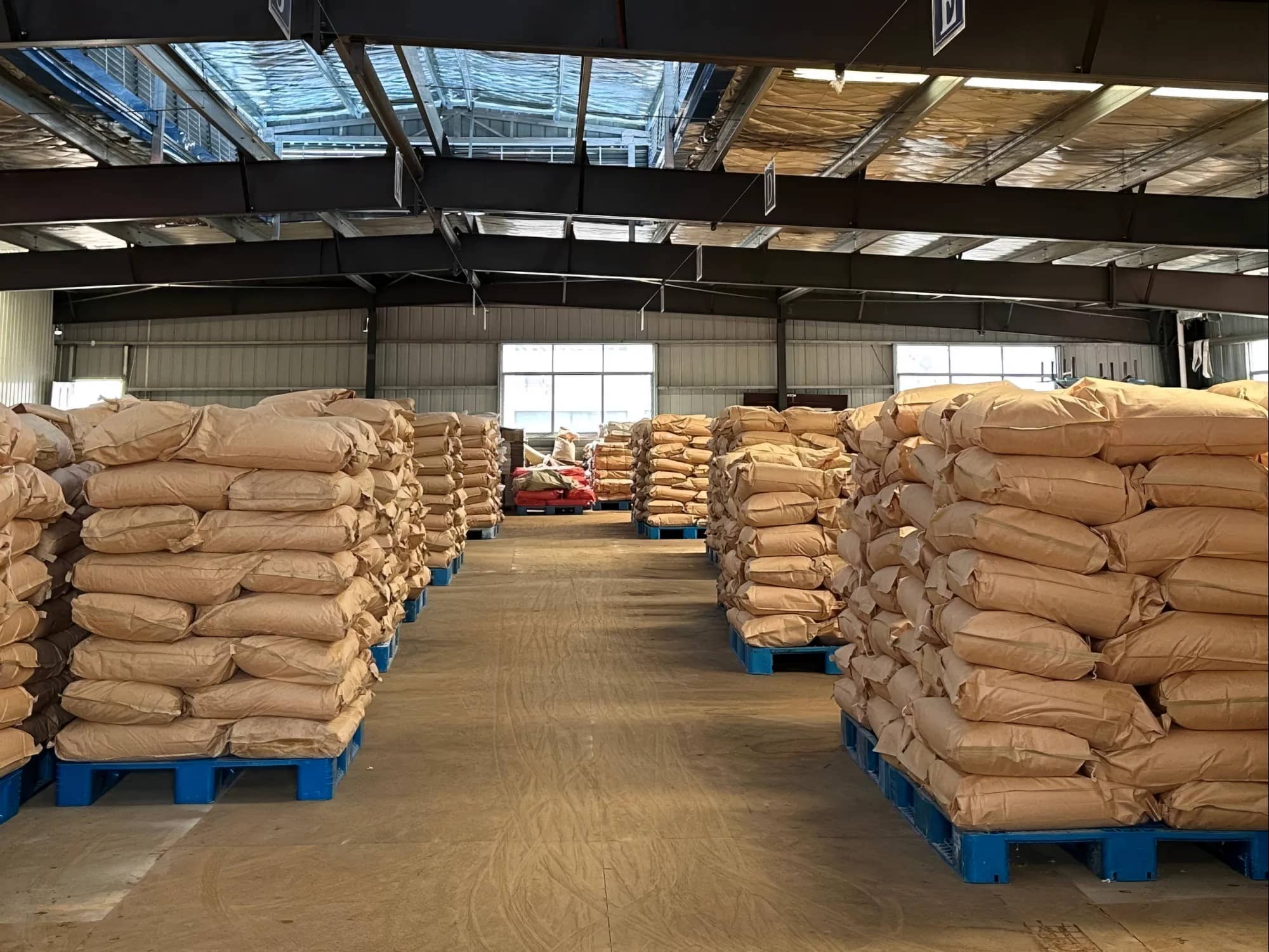
Packed for export.
- Packaging
- 25 kg kraft-composite or PP woven bag with food-grade PE liner · 500 kg / 1 t jumbo bags
- Palletising
- 40 bags = 1 t per pallet, fumigation-free plywood, stretch-wrapped
- Container load
- 20′ GP ≈ 17–20 t · 40′ HQ ≈ 25–28 t
- MOQ
- 1 t for industrial grades · battery grade negotiable
- Lead time
- 7–15 days (stock grades) · 20–30 days (custom)
- Samples
- Free 100–300 g samples, courier collect
- Payment
- T/T 30% deposit, 70% against B/L copy · L/C · D/P
- Incoterms
- FOB · CFR · CIF · EXW
- Documents
- COA · TDS · MSDS/SDS · CO · Form A · Form E
- Inspection
- Customer-appointed SGS / BV inspection accepted
- Port of loading
- Guangzhou — other South China ports on request
[06]FAQ
Battery CMC
Why does chloride content matter in battery-grade CMC?+
Residual sodium chloride from etherification can corrode the copper current collector and raise self-discharge. Sentai battery grades are alcohol-washed to ≤ 0.50 % chloride (as NaCl), and every batch is titrated before release.
What do the gel-particle and filtration figures tell me?+
Undissolved gels and fibres cause pinholes, streaks and filter blinding on the coater. Sentai counts gel particles per 4 cm² film and grades fibre and insolubles A/B; a 500 mL vacuum-filtration time is used as a quick check of slurry cleanliness.
Can Sentai match the viscosity of my current imported CMC?+
Yes. Send the current material's TDS or a sample: our lab benchmarks viscosity, DS, chloride, gel count and filtration side by side and proposes the closest ST grade or a custom viscosity window.
What is the minimum order for battery grade?+
Battery-grade MOQ is negotiable so that cell makers can qualify material at pilot scale. Free 100–300 g samples are available for lab evaluation.
Qualify it in your process.
Free 100–300 g samples with COA, shipped within days. Tell us your formulation and target viscosity — our applications lab will suggest the closest grade.
Related product families
Products
R
Instant CMC
Surface-treated CMC that disperses lump-free and reaches full viscosity fast — DS ≥ 0.95.
F
Food-Grade CMC
Cellulose gum (E466) to GB 1886.232-2016 — thickener, stabiliser and protein protector.
PAC
Oil-Drilling PAC & CMC
Fluid-loss control and viscosity in fresh water to saturated brine — tested to GB/T 5005.
P
Paper-Grade CMC
Wet-end, surface sizing and coating colour CMC — viscosity tuned from 7 to 600 mPa·s.
Insights
Related
- Guide
Oct 10, 2026 · 8 min read
How to Choose Battery-Grade CMC for Lithium-ion Anodes: The Specifications That Matter
A practical guide to specifying battery-grade CMC: purity, chloride, DS, viscosity window versus slurry solids, gel count, fibre class, particle size and moisture, plus test methods and an incoming-inspection checklist.
 Guide
Sep 22, 2026 · 8 min read
How to Read a CMC Spec Sheet: Degree of Substitution vs Viscosity vs Purity
What DS, viscosity and purity really tell you about a sodium CMC grade, why 1 % and 2 % Brookfield viscosities cannot be converted, and how DS drives salt tolerance, acid stability and clarity.
 Guide
Sep 3, 2026 · 7 min read
PAC-LV vs PAC-HV vs Technical CMC in Water-Based Drilling Fluids
How polyanionic cellulose and technical CMC control fluid loss and rheology, how salt, calcium and temperature change the choice, and which grade fits fresh-water, polymer, weighted and saturated-salt muds.