What Is Carboxymethyl Cellulose (CMC)? Uses, Grades and Specs
Sodium carboxymethyl cellulose (CMC, cellulose gum, E466) explained: how it is made, sodium CMC vs CMC, DS, viscosity and purity, uses by industry, powder vs granular vs instant, food safety, price drivers and how to specify a grade.
Sentai Applications Lab · · 9 min read
Carboxymethyl cellulose (CMC) is a water-soluble cellulose ether made by attaching carboxymethyl groups to cellulose from wood pulp or cotton linters. What is sold as CMC is almost always its sodium salt — sodium carboxymethyl cellulose, also called cellulose gum, E466 or CAS 9004-32-4 — a white to off-white powder that dissolves in cold or hot water to give a clear, viscous solution. Industry uses it as a thickener, binder, stabiliser, film former and water-retention agent in products from lithium-ion battery anodes and ice cream to drilling muds, paper coatings and laundry detergents. Three numbers define a grade: degree of substitution (DS), viscosity and purity.
What carboxymethyl cellulose is
Cellulose is a long chain of glucose units, each carrying three hydroxyl groups. In CMC, some of those hydroxyls are converted to carboxymethyl ether groups (–CH₂–COONa). The charged carboxylate groups make the chain soluble in water and give CMC its anionic character, so it adsorbs onto particles and fibres, keeps them apart and thickens water at a low dose.
CMC is made by alkalising cellulose with sodium hydroxide and etherifying it with monochloroacetic acid. The reaction leaves sodium chloride and sodium glycolate as by-products, which battery and food grades remove by repeated washing with aqueous alcohol. Purity is reported on a dry basis as 100 % minus the sum of NaCl and sodium glycolate, so a 99.5 % grade carries no more than 0.5 % of these salts in total.
| Property | Sodium carboxymethyl cellulose |
|---|---|
| Other names | CMC, sodium CMC, Na-CMC, CMC-Na, cellulose gum |
| CAS number | 9004-32-4 |
| Food additive number | E466 (EU), INS 466 (Codex) |
| HS code | 3912.31 (carboxymethylcellulose and its salts) |
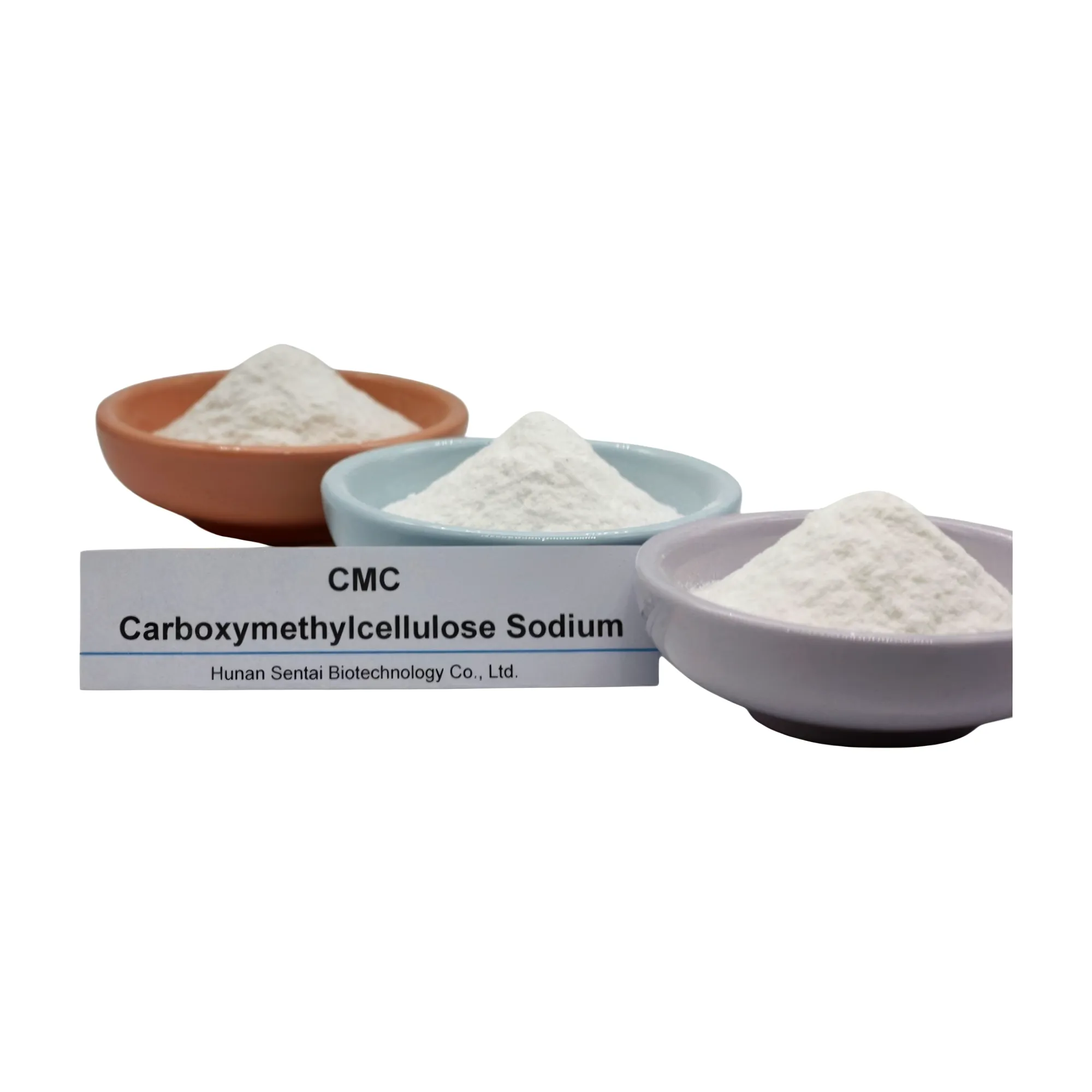
| Appearance | White to off-white powder or granules, odourless |
| Solubility | Dissolves in cold and hot water; insoluble in ethanol and most organic solvents |
| Commercial forms | Fine powder, granular and surface-treated instant grades |
Sodium CMC vs CMC: is there a difference?
In trade and on most specification sheets, “CMC” means the sodium salt. Carboxymethyl cellulose in its free-acid form does not dissolve in water, so it has almost no commercial use; neutralising it with sodium is what makes the product work. A buyer who asks for “sodium CMC”, “CMC-Na” or “cellulose gum” is asking for the same chemistry. The real differences between two CMC products lie in their DS, viscosity, purity and particle form, not in the name.
Two close relatives are often quoted alongside CMC. Polyanionic cellulose (PAC) is also carboxymethyl cellulose, but with a higher and more uniform substitution for salt-water drilling fluids. Sodium carboxymethyl starch (CMS) applies the same chemistry to starch instead of cellulose, giving a cheaper product with lower viscosity and a shorter solution life.
The three numbers that define a CMC grade
Degree of substitution (DS)
DS is the average number of carboxymethyl groups per glucose unit, out of a theoretical maximum of 3. A higher DS improves solubility, clarity and tolerance of salt, hard water and acid; a lower DS costs less and suits applications such as detergents. Sentai grades run from DS 0.4–0.6 for detergent CMC to 0.9 and above for coating grades and PAC, and 0.95 and above for instant grades.
Viscosity
Viscosity reflects chain length (molecular weight) and decides how much CMC you need to reach a target thickness. Sentai's range spans about 5 to 8,000 mPa·s, from low-viscosity paper and detergent grades to high-viscosity drilling, mining and food grades.
High-viscosity grades are specified as a 1 % solution and low-viscosity grades as a 2 % solution, both at 25 °C with a Brookfield viscometer on a dry basis. Never compare values measured at different concentrations.
Purity
Purity is the share of the dry product that is sodium CMC rather than salt by-products. Technical grades keep part of the sodium chloride and sodium glycolate, which is acceptable in detergents, ceramics and drilling fluids and lowers the price; Sentai's technical grades range from about 55 % to 96 %. Battery-grade and food-grade CMC are refined to ≥ 99.5 %, and toothpaste and general industrial grades sit between 98 % and 99.5 %.
What CMC is used for
Across industries CMC does a handful of jobs — thickening, binding, suspending, stabilising, retaining water and forming films — and each application weights them differently. The table maps the main uses to the Sentai product family built for each one.
| Industry | What CMC does | Sentai product family |
|---|---|---|
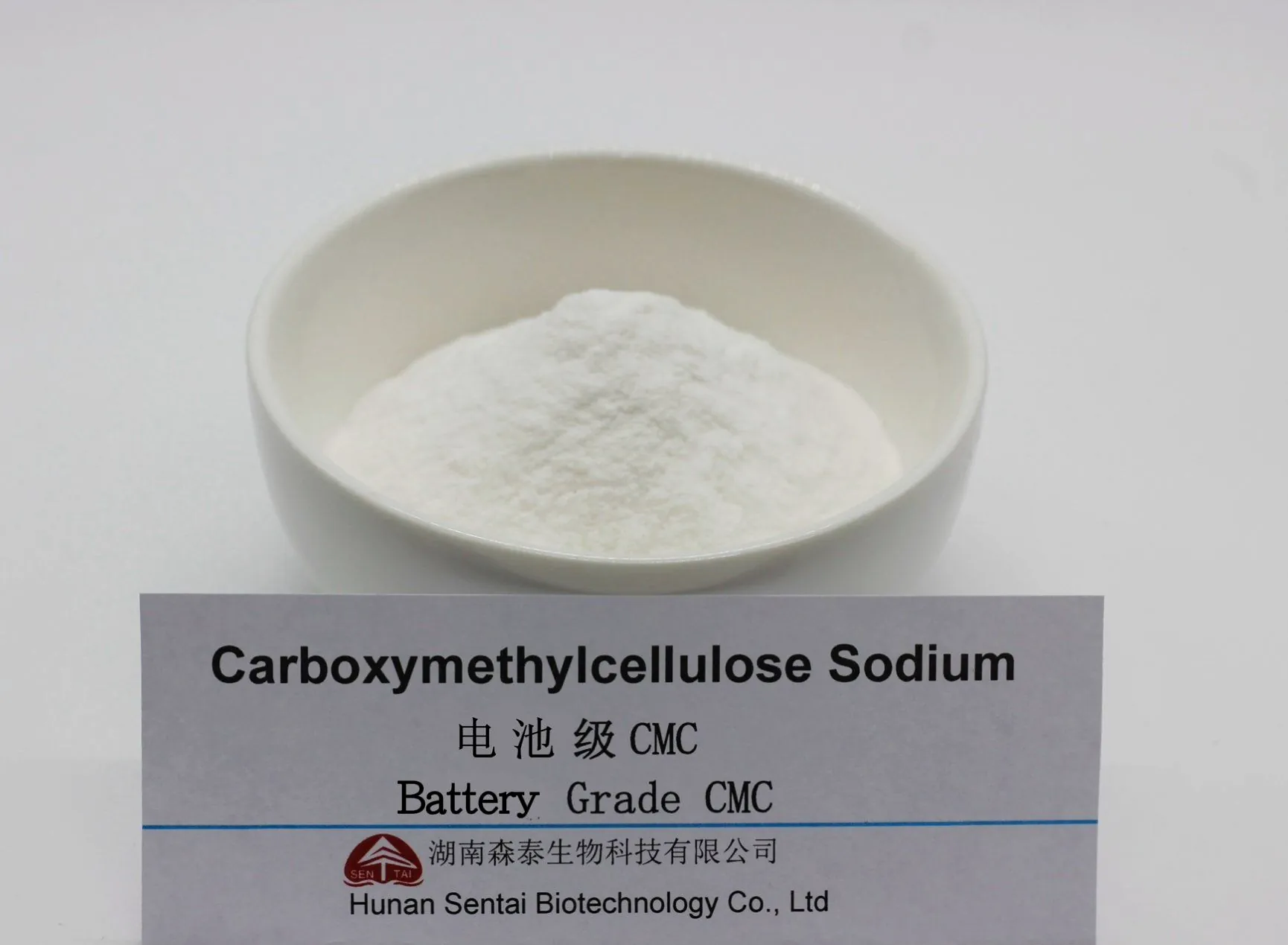
| Lithium-ion batteries | Disperses graphite and, with SBR, binds the anode coating to copper foil | Battery-grade CMC (≥ 99.5 % purity) |
| Food and beverages | Thickens and stabilises acidified milk drinks, ice cream, sauces and bakery fillings | Food-grade CMC (GB 1886.232-2016) |
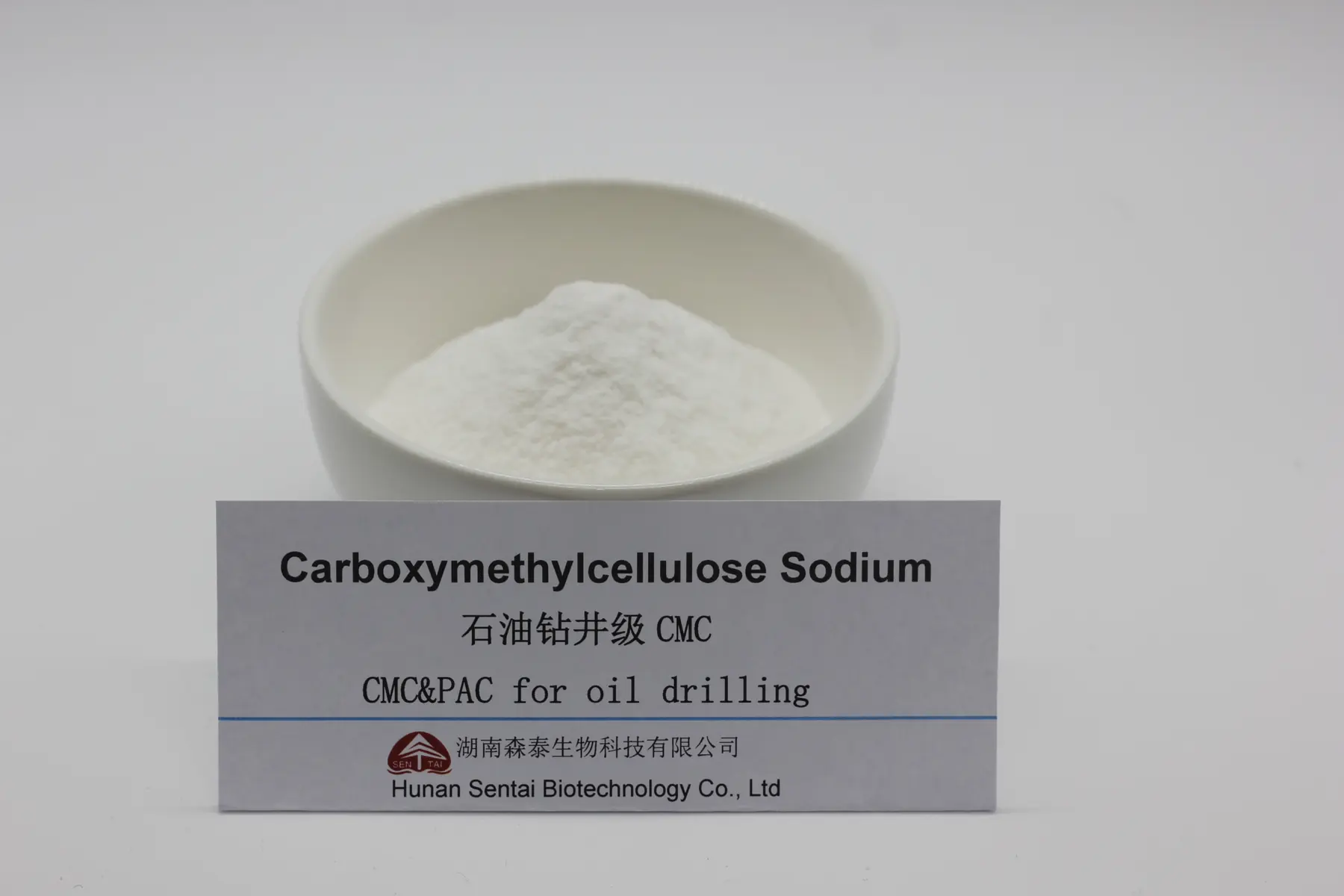
| Oil and gas drilling | Controls fluid loss and builds viscosity in water-based muds | PAC-LV / PAC-HV and drilling CMC (GB/T 5005) |
| Paper | Improves wet-end retention, surface strength and coating-colour rheology | Paper-grade CMC (7–600 mPa·s) |
| Ceramics | Binds tile bodies and keeps glazes and printing glazes in suspension | Ceramic-grade CMC |
| Toothpaste and personal care | Binds and structures the paste | Toothpaste-grade CMC |
| Paints, coatings and putty | Thickens and retains water for workability | Coating-grade CMC |
| Textiles | Sizes warp yarn and thickens printing pastes | Textile-grade CMC |
| Detergents | Stops soil from redepositing on washed fabric | Detergent-grade CMC (DS 0.4–0.6) |
| Mineral processing | Binds iron-ore pellets and depresses gangue minerals in flotation | Mining-grade CMC |
| Any process that needs fast make-down | Disperses without lumps and dissolves quickly | Instant CMC |
| General industry | Thickens, binds and stabilises adhesives and other products | General industrial CMC |
CMC powder, granular or instant?
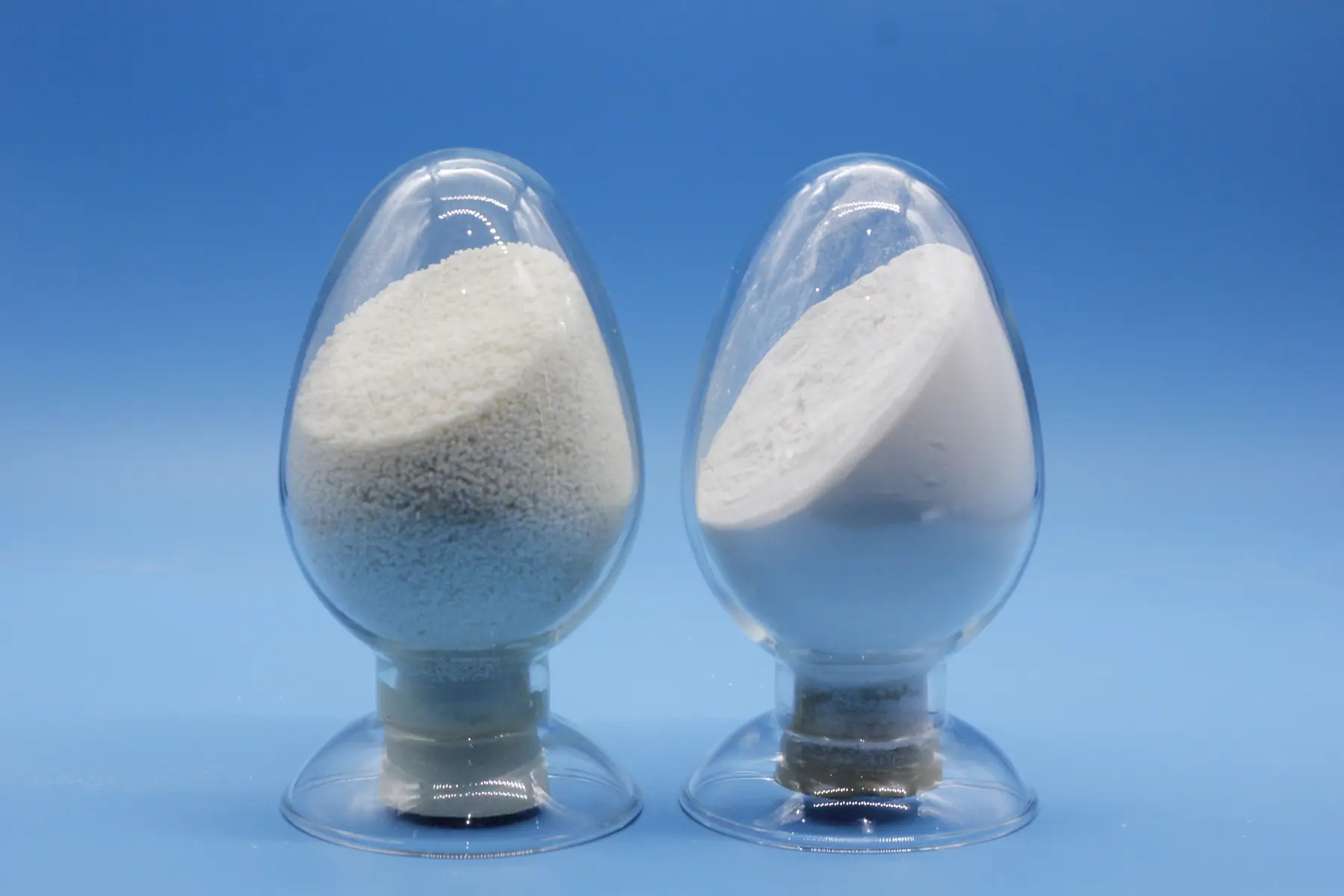
Most CMC ships as a fine powder, which hydrates fastest but forms lumps if it is dumped into water. Granular CMC is agglomerated into larger, free-flowing particles that make less dust and wet out more evenly. Instant CMC is surface-treated so the particles disperse before they swell, which allows lump-free make-down in simple mixers. Sentai can tailor particle size, granulation and surface treatment to a customer's process.
Is CMC safe?
Food-grade sodium carboxymethyl cellulose is an approved food additive in the major markets: E466 in the European Union, INS 466 in the Codex system, generally recognised as safe (GRAS) in the United States under 21 CFR 182.1745 when used in accordance with good manufacturing practice, and covered in China by GB 1886.232-2016. JECFA has evaluated it and set an acceptable daily intake of “not specified”. Only grades made and tested to a food standard may be used in food; technical grades are for industrial use.
What sets the price of CMC
- Purity: refining to ≥ 99.5 % needs repeated washing with aqueous alcohol, so refined grades cost more than technical grades.
- DS and viscosity: a higher substitution uses more reagent, and high-viscosity grades need better cellulose.
- Testing and standards: battery-grade gel counts, food-standard testing and certificates add cost.
- Physical form: granulated and surface-treated instant grades take extra processing steps.
- Packing, volume and Incoterms: 25 kg bags or jumbo bags, full containers and FOB, CFR or CIF terms change the delivered price.
For a quotation, send the application, the target specification and your annual volume; Sentai quotes per grade on FOB, CFR, CIF or EXW terms.
How to specify CMC when you buy
- Describe the application and process: what the CMC must do, at what dose, in what water and at what temperature.
- State the viscosity with its method: concentration (1 % or 2 %), temperature, viscometer, spindle and speed.
- Set DS, purity and sodium chloride limits that match the application.
- Add pH, moisture and particle size, plus dissolution behaviour if lumps are a risk.
- Name the standard you need, such as GB 1886.232-2016 for food or GB/T 5005 for drilling fluids, and ask for a certificate of analysis with every lot.
- Trial a sample in your own formulation before you approve a supplier.
FAQ
What is CMC powder?+
CMC powder is sodium carboxymethyl cellulose in its usual dry form: a white to off-white, free-flowing powder that dissolves in water to form a viscous solution. It is used as a thickener, binder, stabiliser and water-retention agent in batteries, food, drilling fluids, paper, ceramics, detergents and many other products.
Is sodium carboxymethyl cellulose the same as cellulose gum?+
Yes. Cellulose gum is the usual food-label name for sodium carboxymethyl cellulose, which is also listed as E466 or INS 466. Industrial buyers usually say CMC or sodium CMC.
What are the CAS number and HS code of CMC?+
The CAS number of sodium carboxymethyl cellulose is 9004-32-4. CMC and its salts are classified under HS code 3912.31; sodium carboxymethyl starch (CMS) falls under 3505.10.
Is CMC soluble in water?+
Yes. Sodium CMC dissolves in both cold and hot water but not in ethanol or most organic solvents. Add it gradually into a stirred vortex, or use an instant grade, to avoid lumps.
What is the difference between CMC and PAC?+
Both are carboxymethyl cellulose. PAC has a higher and more uniform degree of substitution (≥ 0.9), which gives it better salt and calcium tolerance; technical drilling CMC is the economical choice for fresh-water systems.
Is CMC safe to eat?+
Food-grade CMC is an approved food additive (E466) that JECFA has evaluated, setting an acceptable daily intake of “not specified”. Only material made and tested to a food standard such as GB 1886.232-2016 should be used in food.
Sources
- Carboxymethyl cellulose — Wikipedia
- FAO JECFA Monographs 11 (2011) — Sodium carboxymethyl cellulose specification
- 21 CFR 182.1745 — Sodium carboxymethylcellulose (GRAS)
- ASTM D1439 — Standard Test Methods for Sodium Carboxymethylcellulose
- GB 1886.232-2016 — Food additive sodium carboxymethyl cellulose (standard listing)