How to Read a CMC Spec Sheet: DS, Viscosity, Purity and More
DS, viscosity, purity, pH, moisture, chloride and particle size: what the seven numbers on a CMC spec sheet mean and how to compare grades.
Sentai technical team · · 3 min read
A CMC technical data sheet (TDS) or specification sheet usually lists the same seven numbers: degree of substitution, viscosity, purity, pH, moisture, chloride and particle size. Each one predicts how a grade will behave in your product. This is Part 3 of our CMC glossary: Part 1 sorted the names, Part 2 the jobs, and this part reads the sheet.
In one sentence: compare CMC grades only on numbers measured the same way — same concentration, temperature, viscometer and basis.
Watch the 45-second film
Our paper-cut film walks through the seven numbers in 45 seconds. It is narrated in English, with Afrikaans and Japanese subtitles on YouTube.
- Watch on YouTube
- Watch on LinkedIn
- Watch on Instagram
- Part 1 film: CMC names compared
- Part 2 film: what CMC does
1. Degree of substitution (DS)
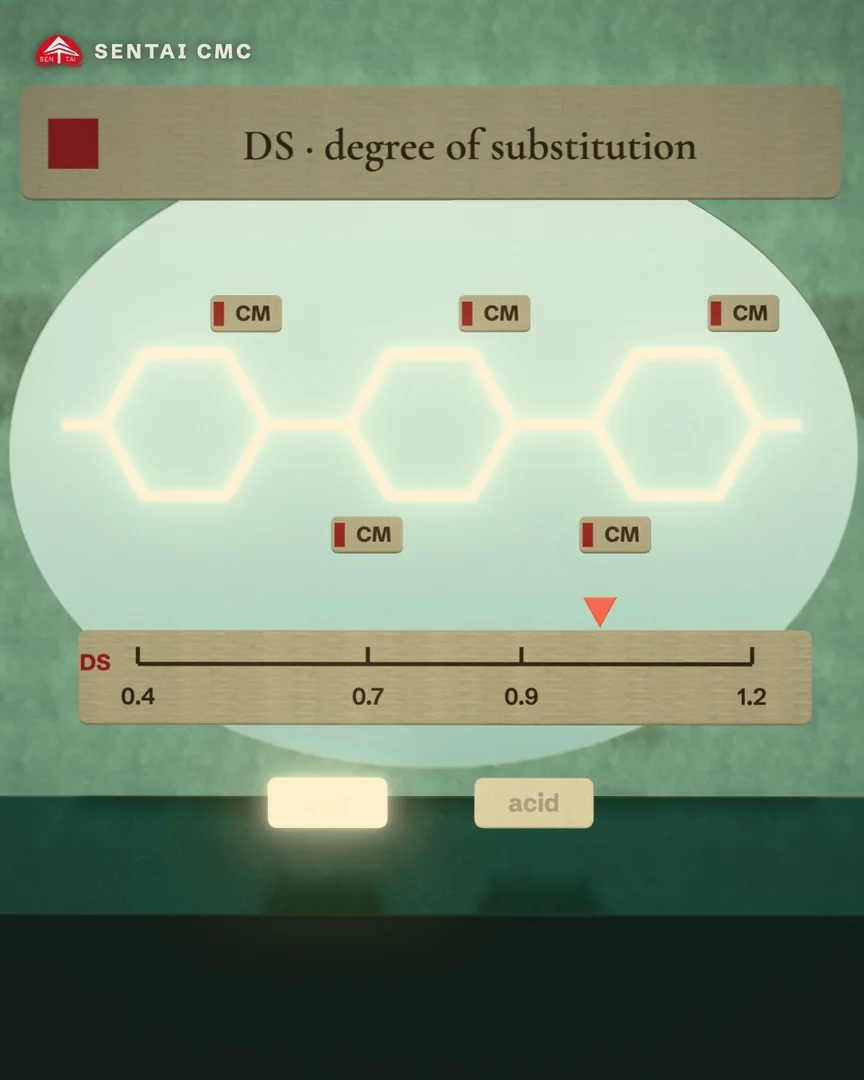
DS is the average number of carboxymethyl groups on each glucose unit of the cellulose chain. Each unit has three hydroxyl groups, so DS could in theory reach 3; commercial CMC usually sits between about 0.4 and 1.2. A higher DS dissolves more completely and copes better with salt, hard water and acid. Food grades for acidified milk drinks, for example, use DS 0.90 or more, while general thickening grades sit around 0.75–0.90.
2. Viscosity
Viscosity is reported in mPa·s, the same unit as centipoise. The value depends on how it was measured: high-viscosity grades are usually given as a 1 % solution and low-viscosity grades as a 2 % solution, at 25 °C on a Brookfield viscometer, on a dry basis. The same powder reads far higher at 2 % than at 1 %, so only compare values measured at the same concentration, temperature, spindle and speed. Sentai grades span about 5 to 8,000 mPa·s.
3. Purity
Purity is the share of sodium CMC in the dry product. The rest is mainly sodium chloride and sodium glycolate, by-products of the reaction. Technical grades keep these salts (about 55–70 % CMC) and suit uses such as drilling or mining where cost matters most; refined grades are washed to 99.5 % or more for food, toothpaste and batteries.
4. pH
pH is measured on a 1 % solution. Most CMC grades fall between 6.0 and 8.5; some technical grades run higher. A value outside the window can point to residual alkali or acid from processing.
5. Moisture (loss on drying)
CMC is hygroscopic: it takes up water from the air. Specifications usually cap loss on drying at 8–10 %, and the food-additive limit is 12 %. Extra moisture means you pay for water, dose less CMC than you think and risk caking, so keep bags sealed and stored dry.
6. Chloride (as NaCl)
Chloride is reported as sodium chloride. It matters most where salt causes corrosion or side reactions: battery-grade CMC for lithium-ion anodes is held to 0.50 % or less.
7. Particle size (mesh)
Particle size is given as the share passing a sieve, for example at least 85 % through 200 mesh (75 µm) for battery grades. Finer powder dissolves faster, but it forms lumps, or fish-eyes, if dumped into water. Add it slowly into a vortex, or choose an instant or granular grade.
Quick reference
- DS: carboxymethyl groups per glucose unit; typically 0.4–1.2
- Viscosity: mPa·s at 25 °C, Brookfield, 1 % or 2 % solution
- Purity: % sodium CMC on a dry basis; technical about 55–70 %, refined 99.5 % or more
- pH: of a 1 % solution; typically 6.0–8.5
- Moisture: loss on drying; typically 8–10 % or less
- Chloride: as NaCl; battery grades 0.50 % or less
- Particle size: % through a mesh; e.g. 85 % or more through 200 mesh (75 µm)
Read next
FAQ
What DS should I choose for CMC?+
It depends on the product. Around 0.75–0.90 suits general thickening; 0.90 or more is better where salt, hard water or acid are present, such as acidified milk drinks, some detergents and drilling fluids.
Why don't two CMC viscosity values match?+
They were probably measured differently. Check the concentration (1 % or 2 %), temperature, viscometer, spindle, speed and whether the value is on a dry basis. Only values measured the same way can be compared.
What does 99.5 % purity mean for CMC?+
At least 99.5 % of the dry product is sodium CMC; less than 0.5 % is salt and glycolate left from the reaction. It is the level required for food use and expected for toothpaste and battery grades.
How should CMC be stored?+
In sealed bags, in a cool, dry place. CMC takes up moisture from the air, which raises its water content and can make the powder cake.
Sources