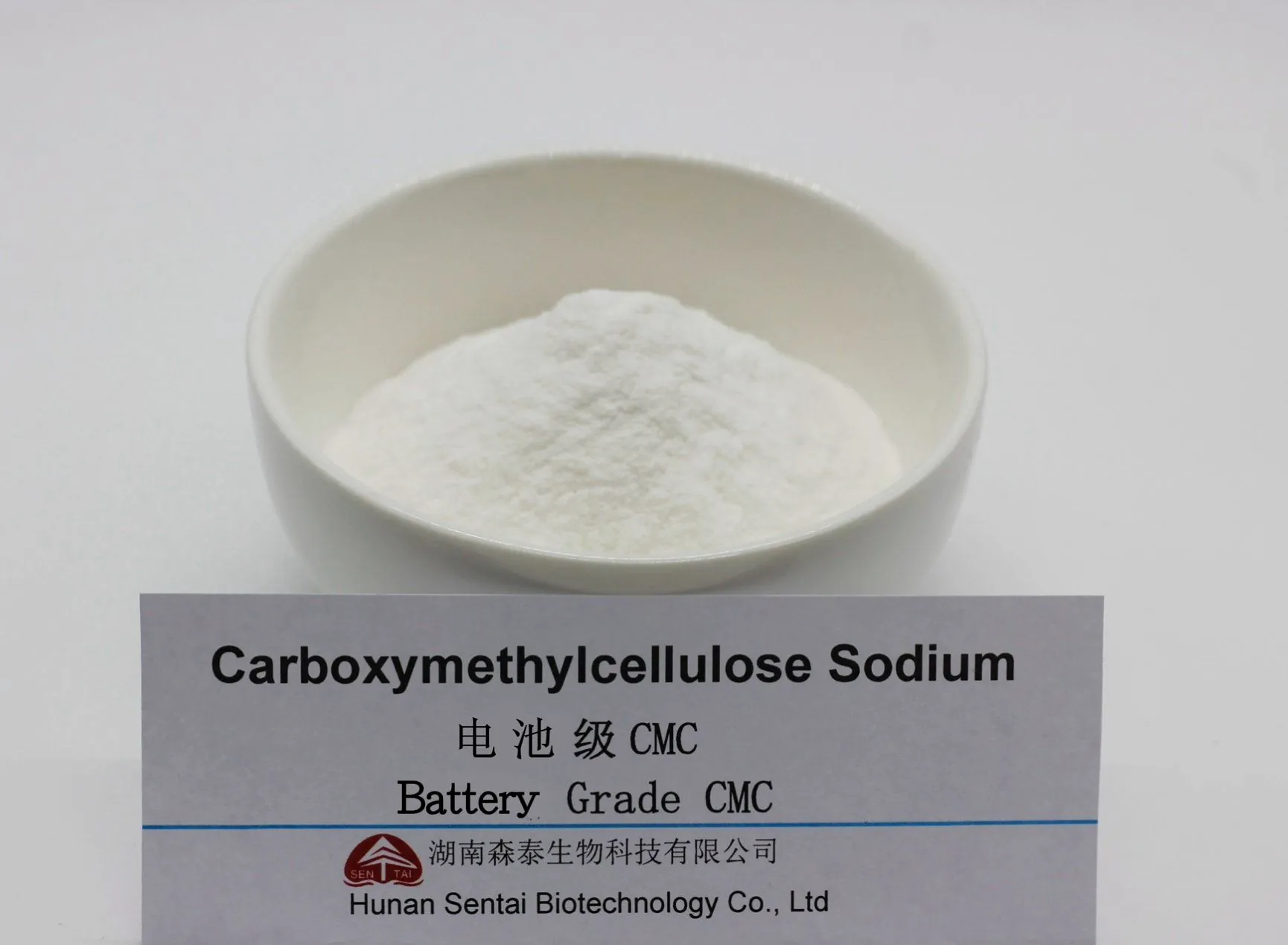
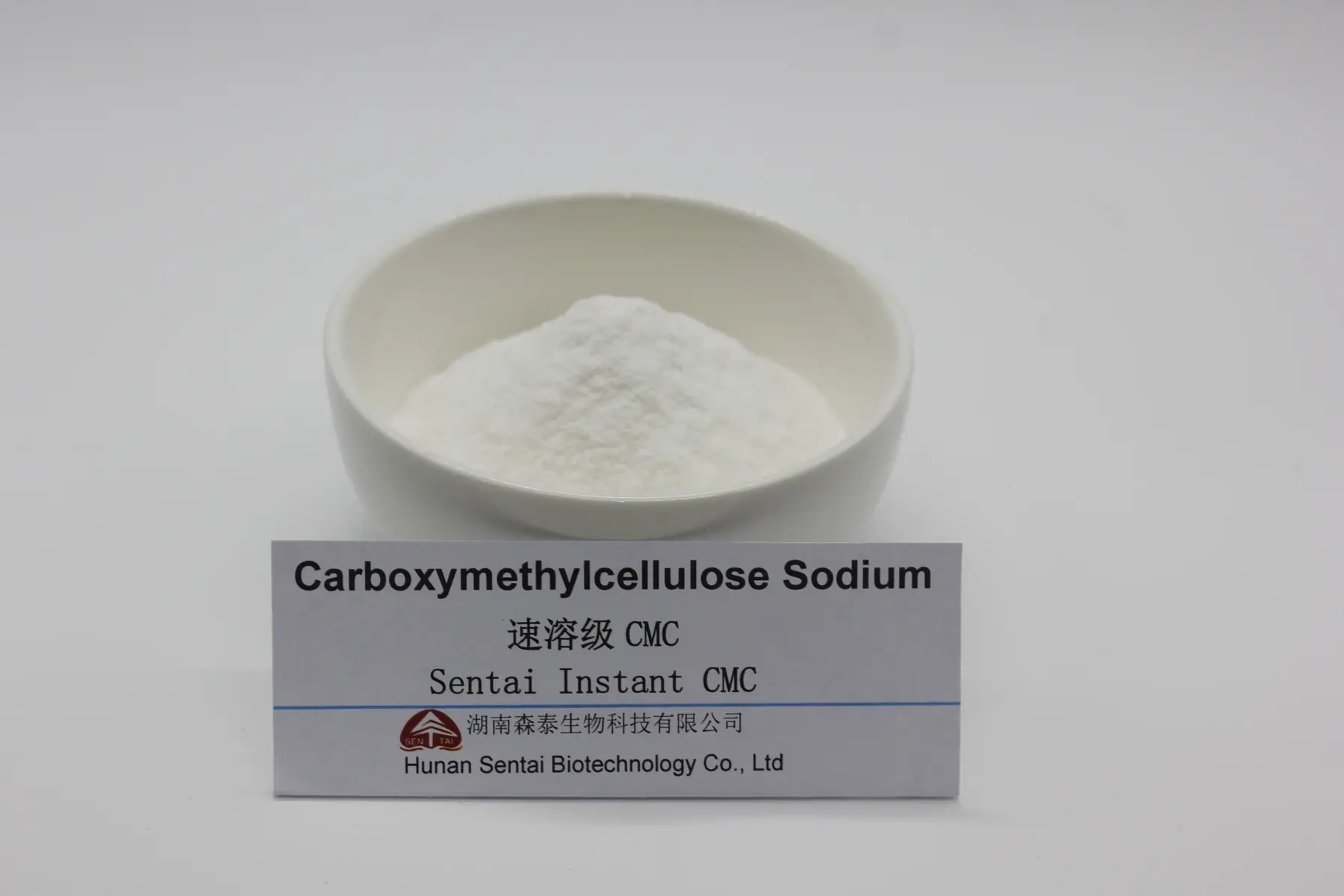
Instant CMC: Why CMC Forms Lumps and How Surface-Treated Grades Dissolve Lump-Free
Why CMC powder forms fish-eyes, the conventional work-arounds, how surface-treated instant CMC delays hydration for lump-free dispersion, and a dissolution procedure for reaching full viscosity first time.
Sentai Applications Lab · · 6 min read
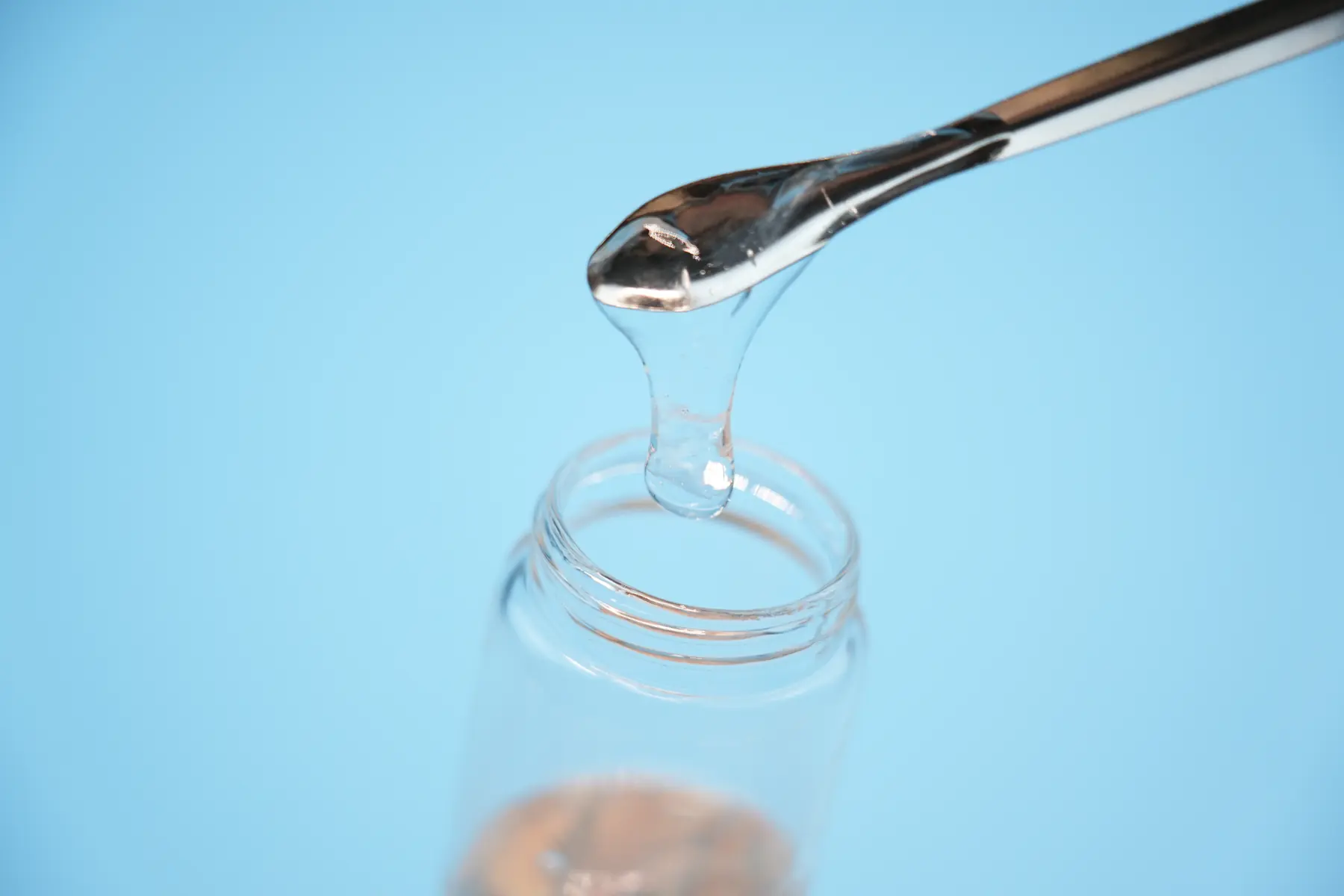
CMC forms lumps, or fish-eyes, because its particles hydrate within seconds of touching water: the outside of a clump swells into a viscous gel skin that stops water from reaching the dry powder inside. Surface-treated instant CMC delays that hydration just long enough for each particle to separate, so the powder can be added straight to water with ordinary stirring and builds viscosity evenly. Once dissolved, it develops the same viscosity profile as an untreated CMC of equal molecular weight.
Why CMC forms fish-eyes
Sodium CMC is strongly hydrophilic. When a pocket of powder lands on water, the outer particles hydrate immediately and form a continuous gel layer of very high viscosity. Water diffuses through that layer only slowly, so the inside of the lump stays dry, sometimes for hours. The fine powders that dissolve fastest as individual particles are also the most prone to clumping, because they wet as a mass.
The consequences go beyond appearance. Lumps take far longer to dissolve, so batch times stretch out. Undissolved gels pass into the product, blind filters and nozzles, and cause defects in films and coatings. Viscosity readings taken before the lumps have gone are low and erratic, and CMC trapped in lumps that are filtered out is simply wasted.
Conventional work-arounds
- Vortex addition: sift the powder slowly into the shoulder of a strong vortex so that particles arrive one at a time. It is effective, but slow and dependent on the operator.
- Dry-blending: mix the CMC with several times its weight of another dry ingredient, such as sugar, salt or pigment, to keep the particles apart.
- Non-solvent slurry: pre-disperse the CMC in glycerol, propylene glycol, ethanol or oil, then add the slurry to water.
- Powder eductors and high-shear mixers: draw the powder into a high-velocity water stream. They work well but need equipment and energy.
Each of these methods works, but each adds time, capital equipment, an extra ingredient or a dependence on operator technique.
How surface-treated instant CMC works
Instant CMC carries a surface treatment that temporarily slows the hydration of each particle. For a short window after the powder meets water, the particles behave almost like an inert powder: they wet, separate and disperse throughout the liquid. The treatment then releases, and each particle swells and dissolves on its own, so viscosity builds uniformly through the whole batch rather than around a few gel lumps. Approaches to delayed hydration differ between producers, and some respond to pH or temperature, so follow the supplier's dissolution guidance.
Granulation is a complementary technique. Agglomerating fine particles into porous granules reduces dust, improves flow in automated dosing and further reduces lumping. Sentai's R-series instant CMC uses a proprietary surface treatment developed in-house and is also available in a granulated version for dust-free dosing.
Untreated versus instant CMC
| Property | Untreated CMC powder | Surface-treated instant CMC |
|---|---|---|
| Behaviour on contact with water | Surface hydrates immediately | Hydration delayed for a short window |
| Risk of lumps (fish-eyes) | High without careful technique | Low with ordinary stirring |
| Addition method | Slowly into a vortex, pre-blended or via an eductor | Directly into water |
| Mixing equipment | Often high shear | Low to moderate shear |
| Time to full viscosity | Long, especially if lumps form; standard laboratory methods allow about 2 h of stirring | Shorter, with uniform viscosity build |
| Final viscosity at equal molecular weight | Reference | Same profile once dissolved |
| Dust | Depends on fineness | Granulated option for low-dust dosing |
| Sentai specification | Grade-dependent | DS ≥ 0.95, purity ≥ 97 %, pH 6.5–8.5, moisture ≤ 10 % |
| Sentai instant grade | 1 % viscosity (mPa·s) |
|---|---|
| C400R | 100–500 |
| C3000R | 2,500–3,500 |
| C4000R | 3,500–4,500 |
| C6000R | 5,500–6,500 |
Dissolution procedure: full viscosity first time
- Weigh on a dry basis by correcting the powder weight for its moisture content.
- Start with the full volume of water in the vessel; soft or deionised water gives the most reproducible viscosity.
- Run the agitator fast enough to form a vortex without drawing in air.
- Add the powder steadily into the shoulder of the vortex over one to several minutes; with instant CMC, normal stirring is enough.
- Keep stirring until no gels remain, and check by drawing a film on glass or pouring through a fine sieve.
- Add salts, acids, solvents and other actives only after the CMC is fully hydrated, because ions in the water slow swelling.
- Measure viscosity at 25 °C after a defined hydration time, and let entrained air escape before taking the reading.
- If the solution will be stored, add a preservative, because CMC solutions can be degraded by microbes and cellulase enzymes.
- Avoid prolonged very high shear with high-viscosity grades, which can mechanically shorten the polymer chains.
Where instant CMC pays off
Instant CMC earns its place wherever dissolution is a bottleneck or high-shear equipment is not available: battery slurry and separator-coating lines that need gel-free solutions quickly, beverage, dairy and instant food mixes, drilling and workover fluids mixed in the field, and water-based paints, adhesives and daily chemicals. The dosage is the same as for a standard CMC of equivalent viscosity, so the savings come from shorter batch times, lower mixing energy and fewer rejected batches.
How Sentai can help
Sentai's Instant CMC family (R-series) covers grades from C200R to C6000R, with DS ≥ 0.95 for clarity and for salt and acid tolerance, plus a granulated option. Send your current dissolution procedure and target viscosity, and the applications team will suggest a grade and a mixing routine to trial. Free 100–300 g samples are available for laboratory evaluation.
FAQ
Why does CMC form lumps in water?+
CMC particles hydrate within seconds. When powder lands in clumps, the outer particles swell into a viscous gel skin that blocks water from reaching the dry powder inside, creating lumps or fish-eyes that can take hours to dissolve.
How do you dissolve CMC without lumps?+
Add the powder slowly into a vortex, dry-blend it with sugar or another powder, pre-disperse it in a non-solvent such as glycerol, or use an eductor. Surface-treated instant CMC avoids these steps because its particles disperse before they start to hydrate.
What is instant CMC?+
Instant CMC is sodium carboxymethyl cellulose with a surface treatment that briefly delays hydration, so the particles disperse individually in water and dissolve without lumps. It reaches full viscosity faster with simple stirring.
Does instant CMC give the same viscosity as regular CMC?+
Yes. Once the powder is dispersed, the treatment releases and the polymer develops the same viscosity profile as an untreated CMC of equal molecular weight. Final viscosity is specified on the technical data sheet.
Does CMC dissolve in cold water?+
Yes. CMC is soluble in both cold and hot water. Warmer water speeds hydration once the powder is dispersed, but it is dispersion technique, not temperature, that prevents lumps.
Sources