
What Does CMC Do? Thickener, Binder, Stabiliser and More
Thickener, binder, stabiliser, water-retention agent, film former, anti-redeposition agent: what each CMC function means and which grade does the job.
Sentai technical team · · 4 min read
Technical data sheets and application notes describe sodium carboxymethyl cellulose (CMC) by what it does: thickener, binder, stabiliser, water-retention agent and more. Each word names a different mechanism, and each favours a different grade. This is Part 2 of our CMC glossary. Part 1 sorted the names of the product and its cousins; this part explains the jobs.
In one sentence: CMC thickens water, binds particles, stabilises proteins, holds water in wet coatings, dries to a film, keeps soil off fabric and limits fluid loss in drilling muds. Which job it does well depends on the grade's degree of substitution (DS), viscosity and purity.
Thickener
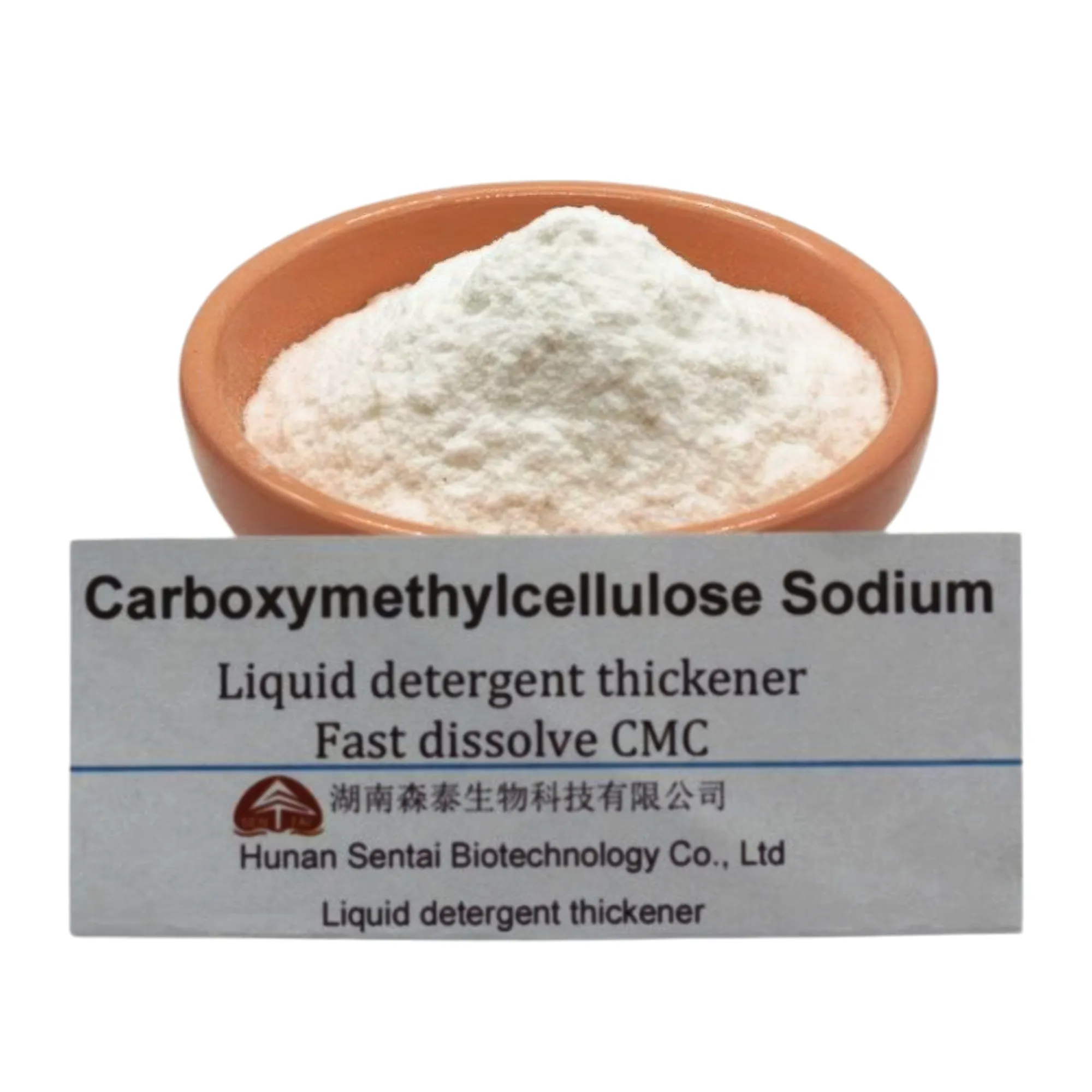
A thickener raises the viscosity of a water-based product. CMC chains carry a negative charge, swell in water and entangle, so a little powder gives a liquid body. CMC solutions are pseudoplastic, or shear-thinning: they flow easily when pumped, poured or brushed and recover their body at rest.
- Where: liquid detergents and soaps, emulsion paints, toothpaste, textile printing pastes, food.
- Grade: liquid detergents need high-purity grades (96 % or more) so that salt does not cloud or thin the product; paints and putties use coating-grade CMC.
Binder
A binder holds particles together once the product dries or is pressed. CMC adds green and dry strength to ceramic tile bodies before firing, holds glaze on the body, and, with SBR, binds graphite in lithium-ion battery anodes. It also binds iron-ore pellets and detergent tablets.
- Where: ceramic bodies and glazes, battery anodes, iron-ore pellets, toothpaste, detergent tablets.
- Grade: ceramic grades from DS 0.6 to 1.0 and above; battery grades at 99.5 % purity or more, with low gel and chloride.
Stabiliser
A stabiliser keeps a dispersion from separating. In acidified milk drinks and drinking yoghurts, a high-DS CMC adsorbs onto the milk proteins and stops them clumping and settling at low pH. In toothpaste it prevents water bleed, and in ice cream it slows the growth of ice crystals.
- Where: acidified milk drinks, ice cream, sauces, toothpaste, battery slurries.
- Grade: food-grade Type 9 CMC (DS 0.90 or more) for acidified milk drinks; Type 6 for neutral foods.
Water-retention agent
A water-retention agent keeps water in a wet layer so that a porous base does not pull it out too fast. In paper coating colours this prevents streaks at the blade; in wall putty and gypsum it gives time to work and prevents cracking.
- Where: paper coating colours, wall putty and gypsum, ceramic glazes, texture finishes.
- Grade: low-viscosity paper-grade CMC for coating colours; coating-grade CMC for putties.
Film former
A film former dries to a continuous, flexible film. At the size press it binds surface fibres, improves ink holdout and adds grease resistance. On warp yarns it forms a sizing film that resists abrasion on the loom and washes off easily afterwards.
- Where: paper surface sizing, textile warp sizing, battery electrodes (with SBR).
- Grade: medium-viscosity paper-grade CMC, or carboxymethyl starch (CMS) where cost matters most.
Anti-redeposition agent
An anti-redeposition agent stops soil that the wash has loosened from settling back on the fabric. CMC adsorbs onto cotton and gives it a negative charge, so suspended soil is repelled and stays in the wash water. This is why laundry powders keep whites white wash after wash.
- Where: laundry powders and detergent bars.
- Grade: technical detergent grades of 55–70 % purity.
Fluid-loss control agent
In water-based drilling muds, polyanionic cellulose (PAC) and CMC build a thin, low-permeability filter cake on the borehole wall. Less water seeps into the formation, which protects the well and keeps the mud stable.
- Where: water-based drilling fluids, from fresh water to saturated brine.
- Grade: PAC-LV to control fluid loss without thickening, PAC-HV to thicken as well; Sentai's PAC grades reach a filtrate loss of 16 mL or less (GB/T 5005).
Other jobs
CMC also works as a dispersant (graphite in battery slurries, pigments in paints), a suspending agent (abrasives in toothpaste, solids in glaze slips) and a flotation depressant for talc and silicate gangue in mining.
Which grade for which job
- Thicken a liquid detergent or soap: high-purity detergent CMC (96 % or more).
- Keep whites white in laundry powder: technical detergent CMC (55–70 %).
- Bind a ceramic body or glaze: ceramic-grade CMC.
- Bind and disperse a battery anode: battery-grade CMC (99.5 % or more).
- Stabilise an acidified milk drink: food-grade Type 9 CMC.
- Hold water in a coating colour or putty: paper- or coating-grade CMC.
- Control fluid loss in drilling mud: PAC-LV or PAC-HV.
Tell us the job, the formula and the process conditions, and we will recommend a grade and send a free sample: sentai-cmc.com/contact
Related guides
- CMC glossary, Part 1: cellulose gum, E466, PAC, CMS and DS
- Carboxymethyl cellulose in detergent
- Food CMC Type 6 vs Type 9 for acidified milk drinks
- Ceramic glaze CMC selection
- How to choose battery-grade CMC
- Paper coating and size-press problems, and how CMC helps
- Wall putty cracking and CMC
- PAC-LV vs PAC-HV in drilling fluids
FAQ
Is CMC a thickener or a stabiliser?+
Both. It thickens water-based products and, in dispersions such as acidified milk drinks or toothpaste, it keeps particles and proteins from separating. Which effect matters depends on the product and the grade.
What is the difference between a binder and a thickener?+
A thickener works while the product is wet, by raising its viscosity. A binder works when the product dries or is pressed, by holding particles together, as in ceramic tile bodies and battery anodes.
Why is CMC used in laundry detergent?+
As an anti-redeposition agent. It adsorbs onto cotton and keeps loosened soil suspended in the wash water instead of letting it settle back on the fabric.
Can one CMC grade do every job?+
No. DS, viscosity and purity decide which function a grade performs well, so a laundry-powder grade will not suit a battery anode or an acidified milk drink. Choose the grade for the job.
Sources