Carboxymethyl Cellulose in Detergent: Grades and Dosage
How CMC stops soil redepositing in the wash, technical (55–70 %) versus high-purity (≥ 96 %) detergent grades, typical dosage in laundry powder, how to add CMC to powders and liquids, and how to test anti-redeposition.
Sentai Applications Lab · · 7 min read
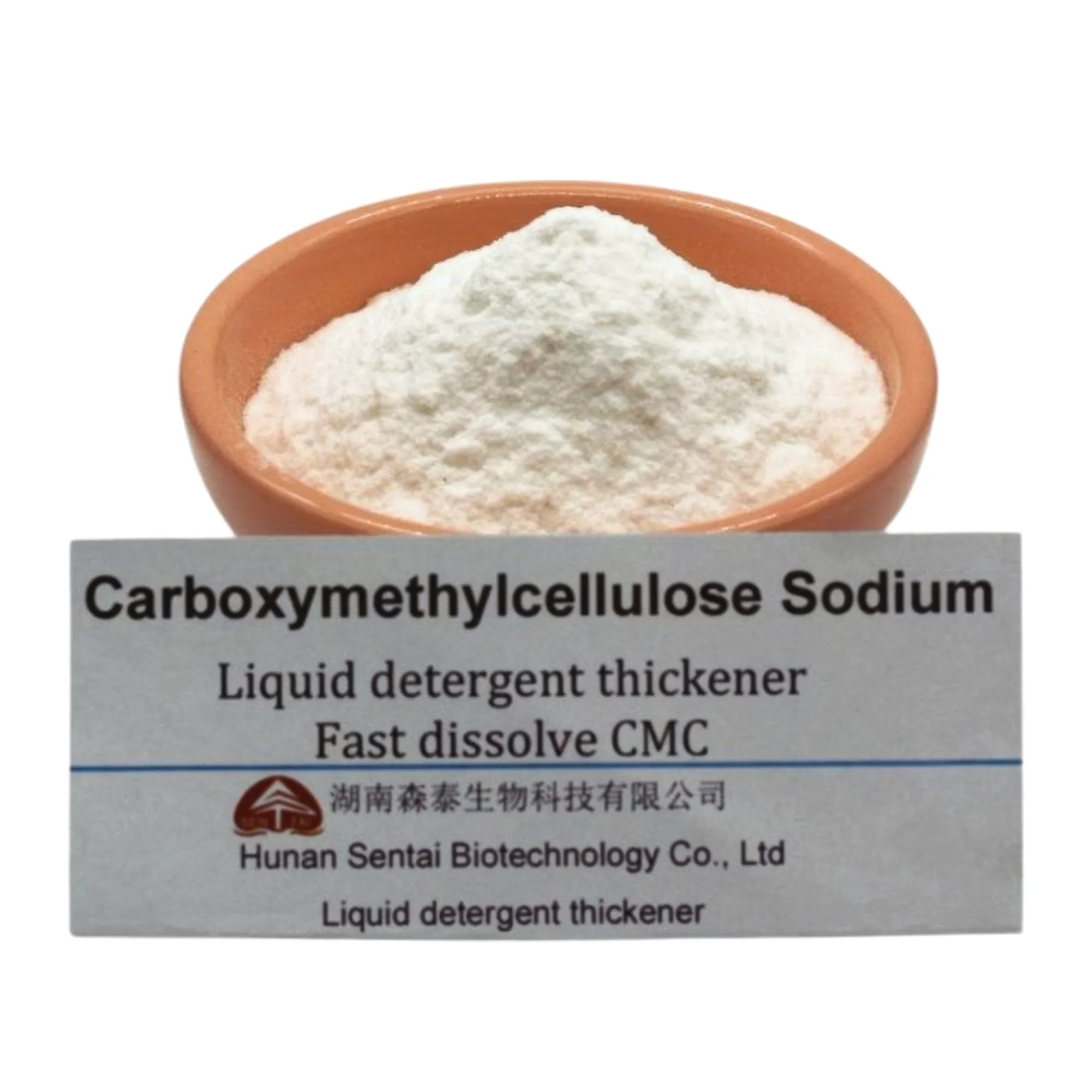
Carboxymethyl cellulose (CMC) is added to laundry detergents as an anti-redeposition agent: it adsorbs onto cotton fibres and onto the soil particles lifted off the fabric, and the negative charge it carries keeps that soil suspended in the wash water instead of letting it settle back on the clothes. Laundry powders use economical technical-grade CMC, typically at 0.5–2.0 % of the formula, with a purity of about 55–70 % and a degree of substitution (DS) of 0.4–0.6. Liquid detergents and soaps use high-purity grades, mainly to thicken. CMC works on cotton and cotton blends but not on polyester, so detergents for mixed loads pair it with a soil-release polymer.
How CMC prevents soil redeposition
During a wash, surfactants and builders lift particulate soil such as clay, soot and pigment off the fabric. Without help, part of it redeposits and white cotton slowly turns grey. CMC is anionic: its carboxylate groups carry a negative charge in alkaline wash water. It adsorbs onto cotton, which is itself cellulose, and onto the suspended soil, so both surfaces carry the same charge and repel each other. The soil stays in the wash liquor and leaves with the rinse water.
The effect builds up over repeated washes, which is why it is measured as whiteness retention over several cycles rather than as stain removal in a single wash. CMC has little effect on oily soils and on hydrophobic synthetic fibres such as polyester; detergents for mixed loads combine it with a soil-release polymer that does that job.
Which CMC grade for which detergent
| Detergent type | What CMC does | Grade type | Sentai grades |
|---|---|---|---|
| Laundry powder (spray-dried or dry-blended) | Anti-redeposition on cotton | Technical: 55–70 % purity, DS 0.4–0.6, low viscosity | ST-20, ST-50, ST-100 |
| Liquid laundry detergent and liquid soap | Thickening and anti-redeposition | High purity: ≥ 96 % | ST-300, ST-500 |
| Dishwashing liquid | Thickening and suspension stability | High purity: ≥ 96 % | ST-300, ST-500 |
| Laundry bars, soap bars and detergent tablets | Binder | Technical or high purity, depending on the formula | Chosen per formula |
Technical grade or high-purity CMC?
Purity is the share of the dry product that is sodium CMC rather than the sodium chloride and sodium glycolate left by the reaction. A laundry powder already contains sodium sulfate, sodium carbonate and other salts, so these by-products do no harm there, and a technical grade gives the same anti-redeposition effect for less money. In a liquid, salt affects viscosity, clarity and stability, so liquid detergents and soaps use refined grades.
| Property | Technical detergent CMC | High-purity detergent CMC |
|---|---|---|
| Purity (dry basis) | 55–70 % | ≥ 96 % |
| Degree of substitution | 0.4–0.6 | Higher; confirm on the grade's TDS |
| Viscosity (Brookfield, 25 °C) | 5–600 mPa·s as a 2 % solution | 2,500–5,500 mPa·s as a 1 % solution |
| pH | 7–10 | 6.5–8.5 |
| Moisture | ≤ 8 % | ≤ 10 % |
| Main use | Laundry powders | Liquid detergents, liquid soaps and dishwashing liquids |
| Sentai grades | ST-20, ST-50, ST-100 | ST-300, ST-500 |
How much CMC to add
A typical laundry powder carries 0.5–2.0 % technical CMC. Compact and premium powders sit at the higher end, as do formulas for hard water or heavily soiled cotton. Because technical grades are sold at 55–70 % purity, compare grades on active content: 1 % of a 60 % grade delivers about 0.6 % sodium CMC.
In liquid detergents the dose is set by the viscosity you want. Run a dose ladder in your own base and measure viscosity at the temperature at which the product will be stored and shipped. Concentrated heavy-duty liquids with high surfactant and low water content leave little room for CMC to dissolve, so check stability over several weeks before you scale up.
How to add CMC to powders and liquids
- Spray-dried powders: add CMC to the crutcher slurry before the tower, where a low-viscosity grade keeps the slurry pumpable, or dry-blend it into the base powder after the tower.
- Dry-blended powders: mix CMC with the other dry ingredients; a granular grade reduces dust and segregation.
- Liquids: sprinkle CMC into the water phase under strong stirring before adding surfactants and salts, or pre-wet it in a water-miscible non-solvent such as propylene glycol or glycerine to avoid lumps.
- Allow full hydration before you measure viscosity; high-viscosity grades need longer.
How to test anti-redeposition
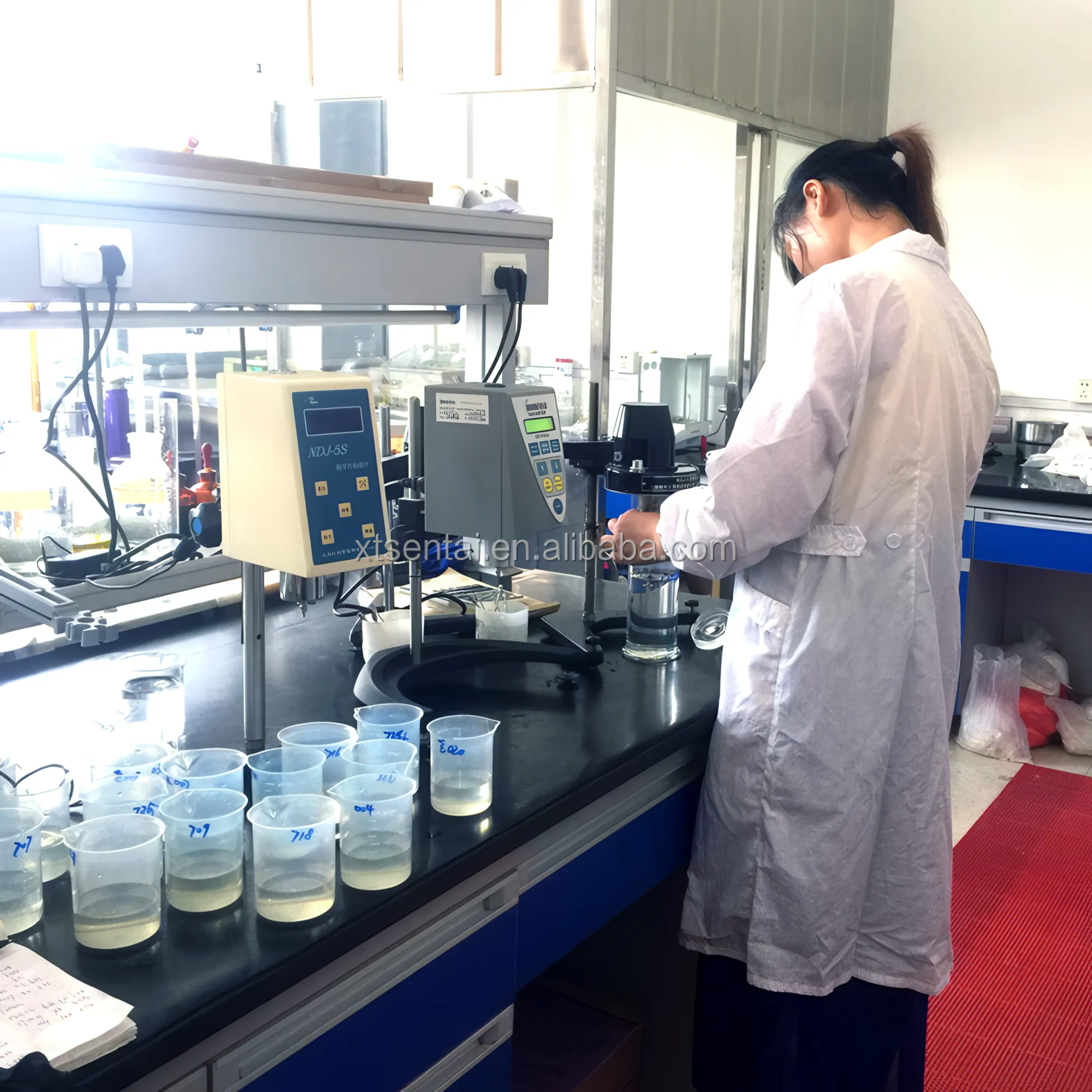
- Wash standard white cotton swatches together with an artificial soil in your detergent, with and without CMC.
- Repeat for several cycles under fixed conditions: water hardness, temperature, dose and liquor ratio.
- Measure whiteness or reflectance before the first wash and after the last; the smaller the loss, the better the anti-redeposition.
- Add polyester and cotton–polyester swatches if you sell into mixed-fibre markets; they show where a soil-release polymer is needed.
ASTM D4008 is a laboratory guide to this test, and China's GB/T 13174 covers the detergency and cycle-washing performance of laundry detergents. Results depend heavily on the soil and fabric used, so agree them, together with a reference detergent, before you compare grades or suppliers.
How to specify detergent CMC
- Purity (active content) on a dry basis, with the test method.
- Viscosity with its concentration, temperature and viscometer; detergent grades are usually specified as a 2 % solution.
- DS range, pH and moisture.
- Particle size, or a granular form if dust and flow matter on your line.
- A certificate of analysis with every lot, and a retained sample of the approved lot.
FAQ
What does CMC do in detergent?+
It is an anti-redeposition agent. CMC adsorbs onto cotton and onto soil particles and keeps loosened soil suspended in the wash water, so the soil rinses away instead of greying the fabric. In liquid detergents it also thickens.
How much CMC is used in washing powder?+
Typically 0.5–2.0 % of the formula as technical-grade CMC. Compare grades on active content and confirm the dose with a multi-cycle whiteness test in your own formula.
Why is detergent-grade CMC only 55–70 % pure?+
The rest is sodium chloride and sodium glycolate from the reaction. Laundry powders already contain salts, so removing them would add cost without improving performance. Liquid detergents use refined grades of ≥ 96 % purity.
Does CMC work on polyester?+
Only weakly. CMC adsorbs onto cellulose fibres such as cotton; for polyester and other hydrophobic synthetics, detergents add a soil-release polymer.
What is the HS code of detergent-grade CMC?+
3912.31, the same as other sodium carboxymethyl cellulose.
Sources
- ASTM D4008 — Standard Guide for Measuring Anti-Soil Deposition Properties of Laundry Detergents
- GB/T 13174-2021 — Determination of detergency and cycle of washing property for laundry detergents (standard listing)
- US 4235735 — Laundry detergent containing cellulose acetate anti-redeposition agent (on CMC's limits with synthetic fabrics)
- Carboxymethyl cellulose — Wikipedia