
CMC Glossary: Cellulose Gum, E466, PAC, CMS and DS Explained
Cellulose gum, sodium CMC and E466 are one product; PAC, CMS and HPMC are not. A glossary of CMC trade terms, with the pairs buyers mix up most.
Sentai technical team · · 4 min read
Buyers meet sodium carboxymethyl cellulose under half a dozen names, and meet several other products whose names sound almost the same. A quotation for "cellulose gum" and one for "sodium CMC" are for the same chemistry; a quotation for PAC or CMS is not. This glossary sorts the terms we see most often in enquiries, specifications and certificates, and compares the pairs that are easiest to mix up.
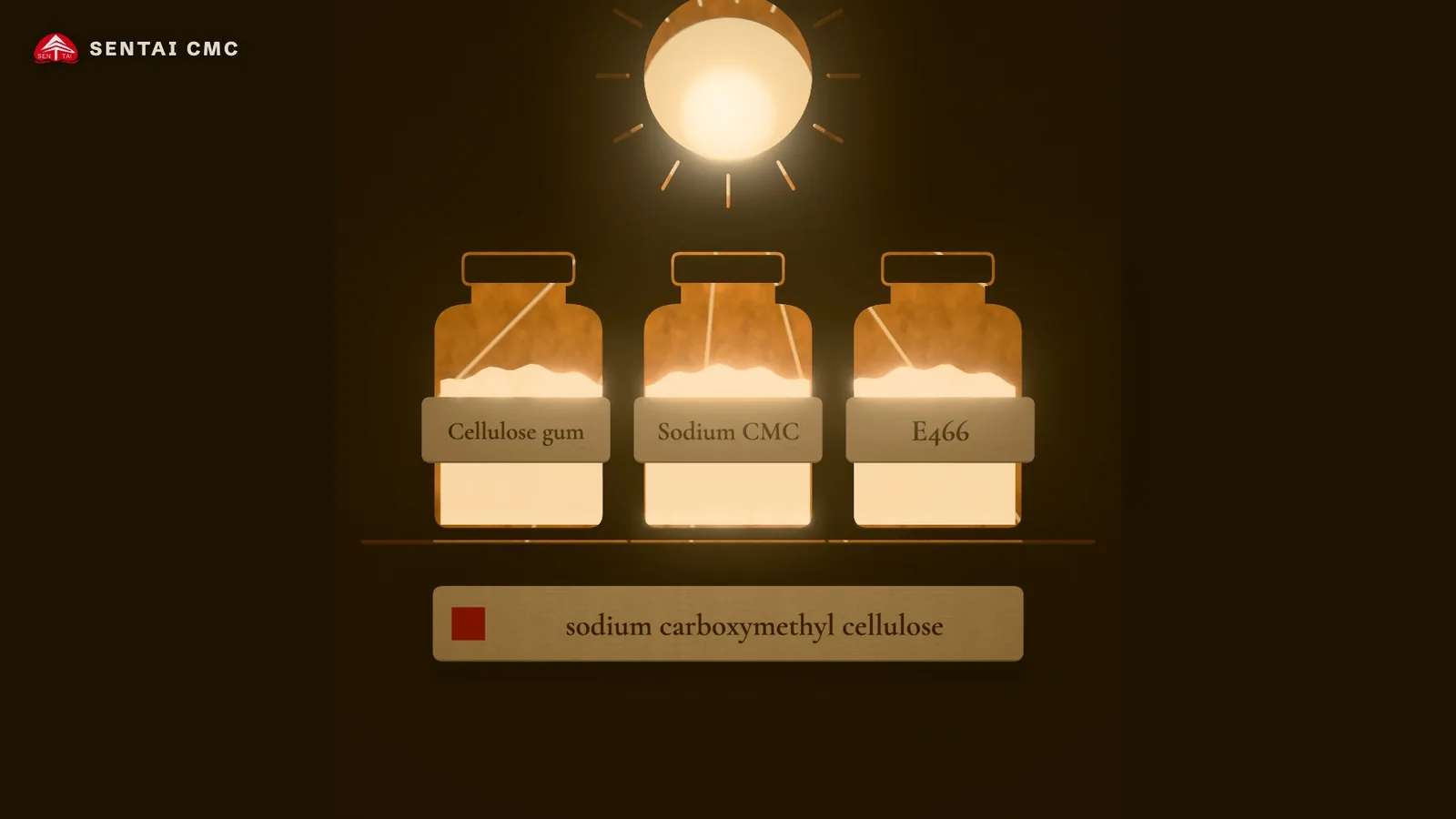
Short answer: CMC, sodium CMC, Na-CMC, cellulose gum, E466 and INS 466 all mean sodium carboxymethyl cellulose (CAS 9004-32-4). PAC is a more highly substituted CMC for drilling fluids. CMS is made from starch, not cellulose. HPMC is a different, non-ionic cellulose ether.
Names for the same product
- CMC (carboxymethyl cellulose): the polymer made by treating cellulose with alkali and monochloroacetic acid. In trade, "CMC" almost always means its sodium salt.
- Sodium CMC, Na-CMC or CMC-Na: the sodium salt, the water-soluble form that is actually sold.
- Cellulose gum: the usual name on food and personal-care labels.
- E466 and INS 466: the food additive number in the European Union and in the Codex system.
- CAS 9004-32-4: the chemical registry number of sodium carboxymethyl cellulose.
- HS 3912.31: the customs heading for carboxymethylcellulose and its salts.
Watch out for E469. It is enzymatically hydrolysed CMC, a separate food additive with shorter chains, not another name for E466.
Related products that are not CMC
CMC vs PAC (polyanionic cellulose) PAC is also carboxymethyl cellulose, made with a higher and more uniform degree of substitution. That makes it more tolerant of salt, up to saturated brine, and better at controlling fluid loss in water-based drilling muds. Sentai's PAC grades have a DS of at least 0.9 and a filtrate loss of no more than 16 mL, tested to GB/T 5005. PAC-LV controls fluid loss while adding little viscosity; PAC-HV also thickens the mud.
CMC vs CMS (carboxymethyl starch) CMS is made by the same reaction, but on starch instead of cellulose. It thickens, binds and retains water at a lower cost, with lower purity and less salt tolerance. Sentai's CMS has a DS of 0.30–0.85, purity of at least 80 % and a 2 % viscosity of 8–300 mPa·s. It is used for paper surface sizing and filler retention, textile sizing and drilling muds.
CMC vs HPMC (hydroxypropyl methylcellulose) HPMC is also a cellulose ether, but a non-ionic one: it carries no charge, so the calcium in cement does not affect it, and it gels when heated. It dominates cement mortars and tile adhesives. CMC is anionic, dissolves in cold or hot water and is the usual choice in detergents, paper, ceramics, food and batteries. Sentai does not make HPMC.
Spec-sheet terms, compared
DS vs viscosity The degree of substitution (DS) is the average number of carboxymethyl groups on each glucose unit of the cellulose chain, at most 3. A higher DS improves solubility and tolerance of salt and acid. Viscosity depends mainly on chain length and on concentration. The two are independent: a grade can have a high DS and a low viscosity.
1 % vs 2 % viscosity High-viscosity grades are measured as a 1 % solution, low- and medium-viscosity grades as a 2 % solution, so a 2 % figure cannot be compared with a 1 % figure. A viscosity is only a specification when the concentration, the temperature and the viscometer (Brookfield or NDJ-1, with spindle and speed) are stated with it.
LV, MV and HV Low, medium and high viscosity. These labels are supplier conventions, not standards: compare the numbers, not the letters.
Technical vs refined grades Purity (assay) is the share of sodium CMC on a dry basis; the rest is mostly sodium chloride and sodium glycolate left from the reaction. Technical grades for laundry powders start at about 55 %; refined grades for food, toothpaste and lithium-ion batteries reach 99.5 % or more.
Regular vs instant CMC Regular CMC hydrates the moment it touches water and can form lumps, often called fish-eyes. Instant CMC is surface-treated so that each particle disperses before it swells. Sentai's instant R-series has a DS of at least 0.95.
Type 6 vs Type 9 food grades Type 6 grades (DS 0.75–0.90) are for neutral foods such as ice cream and sauces. Type 9 grades (DS 0.90 or more) add the acid tolerance that acidified milk drinks need.
TDS vs COA A technical data sheet (TDS) gives the specification ranges of a grade. A certificate of analysis (COA) gives the measured results for one production lot. Sentai ships a COA with every batch.
Which Sentai product to ask for
- Thickening, binding or water retention in most industries: sodium CMC.
- Water-based drilling fluids, including salt water: PAC-LV or PAC-HV.
- The lowest cost per kilogram for paper or textile sizing: CMS.
- Food, toothpaste or lithium-ion batteries: high-purity CMC of 99.5 % or more.
Not sure which term fits your process? Send us your current specification or a sample and we will match it and send a free sample of the closest grade: sentai-cmc.com/contact
Related guides
FAQ
Is cellulose gum the same as CMC?+
Yes. Cellulose gum is the label name for sodium carboxymethyl cellulose, which is also called CMC, sodium CMC or E466.
What is the difference between CMC and PAC?+
PAC is a CMC with a higher and more uniform degree of substitution. It keeps its viscosity and fluid-loss control in salt water, which is why drilling fluids use it.
Can CMS replace CMC?+
In some uses. CMS costs less and works well in paper surface sizing, textile sizing and drilling muds, but CMC is preferred where purity, salt tolerance or long-term solution stability matter.
What does DS mean on a CMC specification?+
DS, the degree of substitution, is the average number of carboxymethyl groups per glucose unit. A higher DS gives better solubility and salt and acid tolerance; it does not set the viscosity.
Sources
- JECFA, Sodium carboxymethyl cellulose, Compendium of Food Additive Specifications, Monograph 11 (2011)
- EFSA Panel on Food Additives and Nutrient Sources, Re-evaluation of celluloses E 460(i), E 460(ii), E 461, E 462, E 463, E 464, E 465, E 466, E 468 and E 469 as food additives, EFSA Journal 16(1):5047 (2018)