CMC Glossary: Cellulose Gum, E466, PAC, CMS and DS Explained
Cellulose gum, sodium CMC and E466 are one product; PAC, CMS and HPMC are not. A CMC glossary with the term pairs buyers mix up most, and the grades.
AuteurZhou Zhi · Responsable du contrôle qualité
Relecture techniqueGuo Jianping · Responsable technique
Publié le · Mis à jour · 6 min de lecture
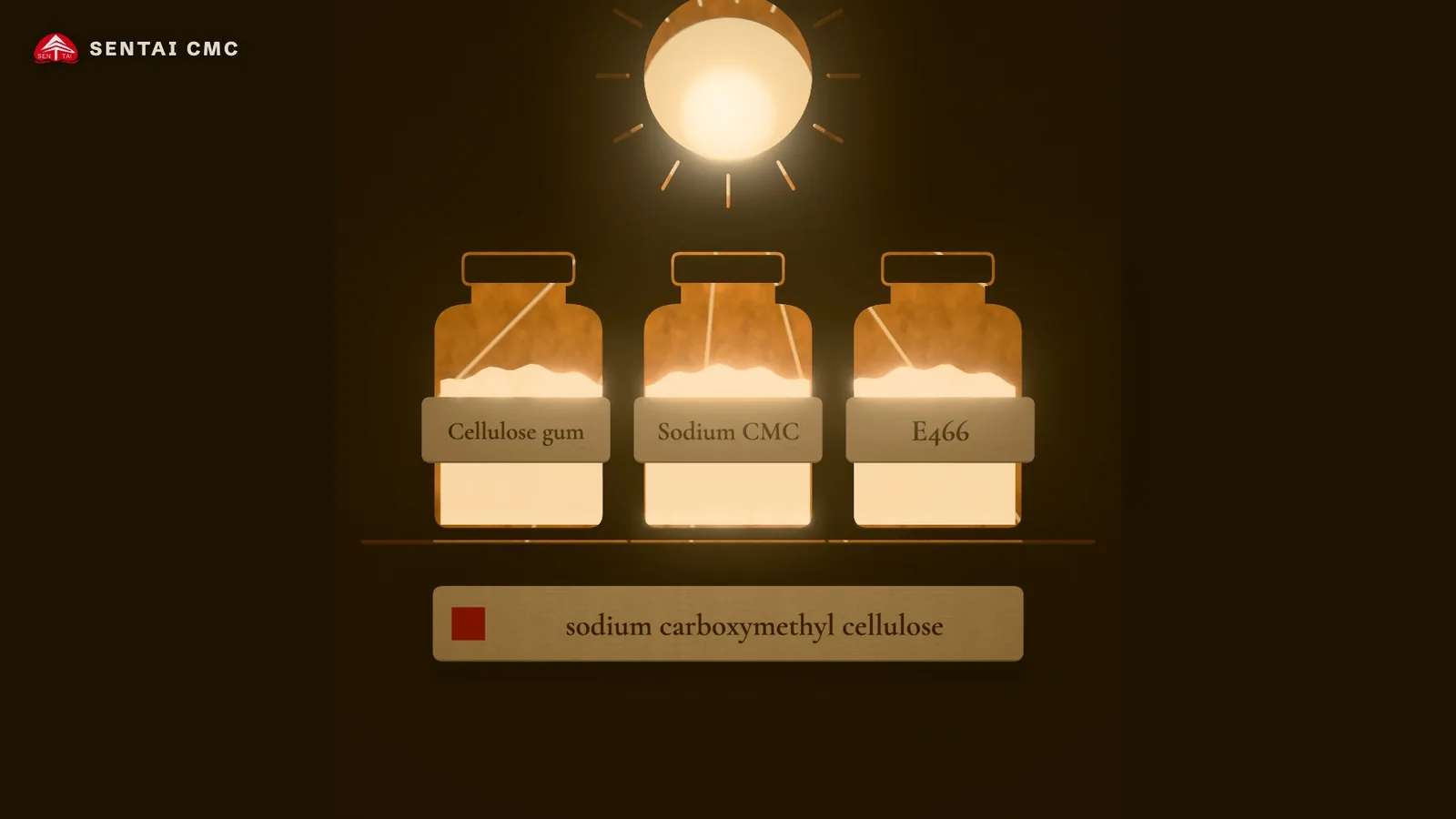
Cellulose gum, sodium CMC, Na-CMC, E466 and INS 466 are all names for one product: sodium carboxymethyl cellulose, CAS 9004-32-4. PAC is a more highly substituted CMC made for drilling fluids, CMS is the same reaction run on starch, and HPMC is a different, non-ionic cellulose ether. On a specification, DS, viscosity and purity are three separate numbers.
This glossary sorts the terms buyers meet in enquiries, specifications and certificates, and compares the pairs easiest to mix up. Sentai makes CMC, PAC and CMS in 13 product families; general industrial CMC covers most thickening, binding and water-retention jobs.
Watch the 45-second film
Our paper-cut film explains the same terms in 45 seconds. It is narrated in English, with Afrikaans and Japanese subtitles on YouTube.
Names for the same product
- CMC (carboxymethyl cellulose): the polymer made by treating cellulose with alkali and monochloroacetic acid. In trade, "CMC" almost always means its sodium salt.
- Sodium CMC, Na-CMC or CMC-Na: the sodium salt, the water-soluble form that is actually sold. "Na" is the chemical symbol for sodium.
- Cellulose gum: the usual name on food labels, and the INCI name on cosmetic and toothpaste ingredient lists. Sentai supplies it as food-grade CMC.
- E466 and INS 466: the food additive number in the European Union and in the Codex system. In the United States, sodium carboxymethylcellulose is GRAS under 21 CFR 182.1745.
- Carmellose sodium (European, British and Japanese pharmacopoeias) and carboxymethylcellulose sodium (United States Pharmacopeia): the medicine names. Sentai does not supply pharmaceutical grades.
- CAS 9004-32-4: the chemical registry number of sodium carboxymethyl cellulose.
- HS 3912.31: the customs heading for carboxymethylcellulose and its salts.
Two look-alike additive numbers are different products. E469 is enzymatically hydrolysed CMC with shorter chains; E468, croscarmellose sodium, is cross-linked CMC that swells without dissolving and makes tablets break apart. Our full list of CMC names and look-alikes adds the pharmacopoeia and customs details.
Related products that are not sodium CMC
CMC vs PAC (polyanionic cellulose)
PAC is also carboxymethyl cellulose, made with a higher and more uniform degree of substitution. That makes it more tolerant of salt, up to saturated brine, and of calcium, and better at controlling fluid loss in water-based drilling muds. Sentai sells it in its oil-drilling PAC and CMC range, tested to GB/T 5005 in fresh water, 4 % brine and saturated brine.
Both Sentai PAC grades have a DS of at least 0.9 and a filtrate loss of no more than 16 mL. PAC-LV, with an apparent viscosity of 40 mPa·s or less, controls fluid loss while adding little viscosity; PAC-HV, at 50 mPa·s or more, also thickens the mud.
CMC vs CMS (carboxymethyl starch)
CMS is made by the same reaction, but on starch instead of cellulose (CAS 9063-38-1, HS 3505.10). It thickens, binds and retains water at a lower cost per kilogram, with lower purity and less salt tolerance. Sentai makes sodium carboxymethyl starch on a dedicated 5,000 t/yr line: DS 0.30–0.85, purity of at least 80 % for the H, M and L grades, and a 2 % viscosity of 8–300 mPa·s.
CMS is used for paper surface sizing and filler retention, textile sizing and drilling muds; the CMS-P paper grade also works as a filler stabiliser, retention aid and coating binder.
CMC vs HPMC (hydroxypropyl methylcellulose)
HPMC is a non-ionic cellulose ether: it carries no charge, so the calcium in cement does not affect it, and it gels when heated, which is why it dominates mortars and tile adhesives. CMC is anionic and is the usual choice in detergents, paper, ceramics, food and batteries. Sentai does not make HPMC.
Spec-sheet terms, compared
DS vs viscosity
The degree of substitution (DS) is the average number of carboxymethyl groups on each glucose unit of the cellulose chain; commercial CMC sits between about 0.4 and 1.5. A higher DS improves solubility and tolerance of salt and acid.
Viscosity depends mainly on chain length and concentration, so the two are independent: a grade can have a high DS and a low viscosity. Our guide to degree of substitution and viscosity shows how each is measured.
1 % vs 2 % viscosity, and mPa·s vs cP
High-viscosity grades are measured as a 1 % solution and low- and medium-viscosity grades as a 2 % solution; the two cannot be converted with a fixed factor. A viscosity is only a specification when the concentration, temperature and viscometer (Brookfield or NDJ-1, with spindle and speed) are stated with it. The unit mPa·s equals the centipoise (cP).
LV, MV and HV
Low, medium and high viscosity. For CMC these labels are supplier conventions, not standards: compare the numbers, not the letters. PAC-LV and PAC-HV are the exception, because API 13A and ISO 13500 define both grade types for drilling fluids.
Technical vs refined grades
Purity (assay) is the share of sodium CMC on a dry basis; the rest is mostly sodium chloride and sodium glycolate left from the reaction. Technical grades such as detergent-grade CMC for laundry powders are 55–70 % pure. Refined grades, washed with aqueous alcohol to 99.5 % or more, serve food and lithium-ion batteries, as in battery-grade CMC.
Regular vs instant CMC
Regular CMC hydrates the moment it touches water and can form lumps, often called fish-eyes. Instant CMC is surface-treated so that each particle disperses before it swells. Sentai's R-series has a DS of at least 0.95 and a purity of at least 97 %; C3000R gives 2,500–3,500 mPa·s as a 1 % solution.
Type 6 vs Type 9 food grades
Type 6 grades (DS 0.75–0.90) are for neutral foods such as ice cream and sauces. Type 9 grades (DS 0.90 or more) add the acid tolerance that acidified milk drinks need. The difference is DS, not viscosity: FH6A and FH9A both read 200–500 mPa·s as a 1 % solution.
TDS, COA and SDS
A technical data sheet (TDS) gives a grade's specification ranges, a certificate of analysis (COA) the measured results of one production lot, and a safety data sheet (SDS) handling and safety. Sentai ships a COA with every batch; Part 3 explains how to read a CMC spec sheet.
Which Sentai product to ask for
- Adhesives, building materials and general industry: general industrial CMC.
- Water-based drilling fluids, including salt water: PAC-LV or PAC-HV.
- Lowest cost per kilogram for paper or textile sizing: CMS.
- Food and beverages: food-grade CMC, 99.5 % pure or more, to GB 1886.232-2016.
- Toothpaste: toothpaste-grade CMC, 98 % pure or more.
- Lithium-ion anodes: battery-grade CMC, 99.5 % pure or more.
- Laundry powders: detergent-grade CMC.
- Lump-free mixing: instant CMC.
Checklist: what to put on an enquiry
- Le nom chimique et le numéro CAS : carboxyméthylcellulose sodique, CAS 9004-32-4.
- The application, or the product family you need.
- Viscosity with its concentration, temperature and viscometer.
- DS and purity on a dry basis, and the form: powder, granular or instant.
- The standard your market requires, and HS code 3912.31 for customs.
Next step
Compare every grade side by side in Sentai's CMC, PAC and CMS range. Not sure which term fits your process? Send us your current specification or a sample and we will match it to the closest grade and send a free 100–300 g sample with its COA.
FAQ
Is cellulose gum the same as CMC?+
Yes. Cellulose gum is the label name for sodium carboxymethyl cellulose, CAS 9004-32-4, which is also called CMC, sodium CMC, Na-CMC, E466 or INS 466. What differs from one product to the next is the grade, defined by its degree of substitution, viscosity and purity, not the name on the label.
Quelle est la différence entre la CMC et la PAC ?+
PAC, polyanionic cellulose, is a CMC with a higher and more uniform degree of substitution, typically 0.9 or more. It keeps its viscosity and fluid-loss control in salt water and with calcium present, which is why water-based drilling fluids use it. Regular CMC is the economical choice for fresh-water muds and most other industries.
Can CMS replace CMC?+
In some uses. CMS is made from starch, costs less per kilogram and works well in paper surface sizing, textile sizing and drilling-mud fluid-loss control. CMC is preferred where high DS, high purity, salt tolerance or long-term solution stability matter, as in food, toothpaste and batteries.
What does DS mean on a CMC specification?+
DS, the degree of substitution, is the average number of carboxymethyl groups on each glucose unit of the cellulose chain. A higher DS gives better solubility and tolerance of salt and acid; 0.9 or more is the usual threshold for acidic or salty systems. DS does not set the viscosity, which depends mainly on chain length.
Sources
- JECFA, Sodium carboxymethyl cellulose, Compendium of Food Additive Specifications, Monograph 11 (2011)
- EFSA Panel on Food Additives and Nutrient Sources, Re-evaluation of celluloses E 460(i), E 460(ii), E 461, E 462, E 463, E 464, E 465, E 466, E 468 and E 469 as food additives, EFSA Journal 16(1):5047 (2018)
- 21 CFR 182.1745, Sodium carboxymethylcellulose (US eCFR)
- ASTM D1439, Standard Test Methods for Sodium Carboxymethylcellulose
- GB 1886.232-2016, National food safety standard: food additive sodium carboxymethyl cellulose (standard listing)
- GB/T 5005-2010, Specifications of drilling fluid materials (standard listing)
Zhou Zhi · 周智
Responsable du contrôle qualité
- 15 ans en contrôle qualité et R&D CMC
Relecture technique: Guo Jianping · Responsable technique
Rencontrer l’équipe