How to Read a CMC Spec Sheet: DS, Viscosity, Purity and More
DS, viscosity, purity, pH, moisture, chloride and particle size: the seven numbers on a CMC spec sheet, read line by line on a real Sentai grade.
AuteurZhou Zhi · Responsable du contrôle qualité
Relecture techniqueGuo Jianping · Responsable technique
Publié le · Mis à jour · 5 min de lecture
To read a CMC spec sheet, check seven numbers and the test conditions printed beside each: degree of substitution (DS), viscosity, purity, pH, moisture, chloride and particle size. DS sets salt and acid tolerance, viscosity sets thickening power, and purity tells you how much of the powder is sodium CMC. Compare two grades only on numbers measured the same way.
Every grade in Sentai's CMC, PAC and CMS range has a spec page in the same layout, from general industrial CMC to food and drilling grades. The page lists the limits used for release testing; the full technical data sheet (TDS) adds typical values and test methods.
This guide reads one real sheet line by line: ST-3, a mid-viscosity grade from Sentai's battery-grade CMC family, chosen because it carries all seven numbers. It is Part 3 of our CMC glossary series.
Watch the 45-second film
Our paper-cut film walks through the seven numbers in 45 seconds. It is narrated in English, with Afrikaans and Japanese subtitles on YouTube.
- Watch on YouTube
- Watch on LinkedIn
- Watch on Instagram
- Part 1 film: CMC names compared
- Part 2 film: what CMC does
- Part 4 film: seven CMC grades compared
The example sheet: ST-3 battery-grade CMC
The header identifies the product: sodium carboxymethyl cellulose, CAS 9004-32-4, HS 3912.31. The limits table then reads:
- Viscosity: 1,500–2,000 mPa·s (Brookfield, 1 % solution, 25 °C)
- Degree of substitution: 0.8–1.0
- Purity: 99.5 % or more (dry basis)
- pH (1 % solution): 6.0–8.5
- Moisture (loss on drying at 105 °C): 10 % or less
- Chloride (as NaCl): 0.50 % or less
- Particle size: 85 % or more through 200 mesh (75 µm)
- Gel particles: 5 or fewer per 4 cm²; fibre and insolubles: Class A
Under the table, the sheet lists typical applications, the dosage (0.8–1.5 % of electrode solids for this family), packaging, storage and the documents supplied, among them the COA, TDS and SDS. The sections below take each number in turn.
1. Degree of substitution (DS)
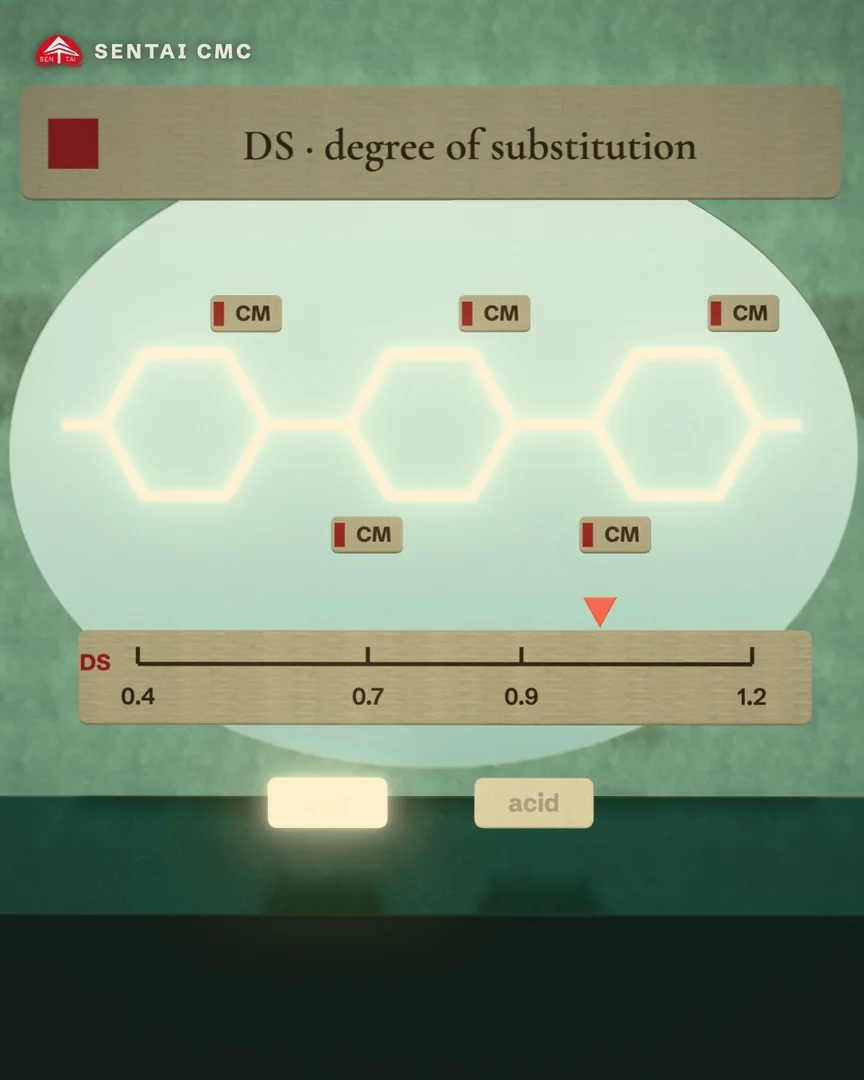
DS is the average number of carboxymethyl groups on each glucose unit of the cellulose chain. Each unit has three hydroxyl groups, so DS could in theory reach 3; commercial CMC usually sits between about 0.4 and 1.5. It is determined by titration, as described in GB 1886.232 and ASTM D1439.
A higher DS dissolves more completely and copes better with salt, hard water and acid. ST-3's window of 0.8–1.0 sits in the usual band for food and battery grades. Neutral, low-salt systems tolerate DS 0.7–0.9; acidic, salty or hard-water systems need 0.9 or more, which is why Type 9 food grades and PAC-LV are specified at 0.9 or more.
2. Viscosity
Viscosity is reported in mPa·s, the same unit as the centipoise (cP), and it means something only with its conditions. ST-3's 1,500–2,000 mPa·s is a 1 % solution on a Brookfield viscometer at 25 °C, on a dry basis; Sentai measures at 25 ± 0.1 °C, with the spindle and speed set by the range.
High-viscosity grades are quoted at 1 % and low-viscosity grades at 2 %, and there is no fixed factor between them: doubling the concentration typically raises viscosity several-fold. CMC solutions are also shear-thinning and read lower when warmer. Check the width of the window as well as its midpoint. Our guide to degree of substitution and viscosity explains the measurement in depth.
3. Purity
Purity is the share of sodium CMC in the dry product: 100 % minus the sodium chloride and sodium glycolate formed as by-products of the reaction. ST-3 is refined to 99.5 % or more, the level used for food and battery grades.
Technical grades keep the salts. ST-50, a laundry-powder grade, is 55–70 % pure with a DS of 0.4–0.6. Always calculate the dose on an active basis: 1 % of a 60 % grade delivers only about 0.6 % sodium CMC.
4. pH
pH is measured on a 1 % solution at 25 °C. ST-3 specifies 6.0–8.5, and most refined grades fall between about 6.0 and 8.5. Technical grades can run more alkaline: ST-50 allows pH 7–10. A value outside the stated window can point to residual alkali or acid from processing.
5. Moisture (loss on drying)
Moisture is the weight lost on drying at 105 °C to constant mass. CMC is hygroscopic, so specifications cap it: 10 % or less for ST-3, 8 % or less for Sentai food grades, and 12 % in the JECFA food-additive specification. Extra moisture means you pay for water, dose less CMC than you think and risk caking, so keep bags sealed and stored dry.
6. Chloride (as NaCl)
Chloride is titrated and reported as sodium chloride. It matters most where salt causes corrosion or side reactions: residual NaCl can corrode the copper current collector of a lithium-ion anode, so ST-3 and the other battery grades are held to 0.50 % or less. Food grades carry the same 0.5 % limit.
7. Particle size (mesh)
Particle size is the share of the powder that passes a test sieve. ST-3 requires 85 % or more through 200 mesh, a 75 µm opening in the ASTM E11 sieve series. Finer powder dissolves faster but forms lumps, or fish-eyes, if dumped into water. Add it slowly into a vortex, or choose instant CMC or a granular grade.
Lines only some sheets carry
- Battery grades: gel particles per 4 cm² of film and a fibre and insolubles class, because gels cause pinholes and streaks on the coater.
- Drilling grades: apparent viscosity and filtrate loss to GB/T 5005, for example 40 mPa·s or less and 16 mL or less for PAC-LV.
- Food grades: sodium glycolate, arsenic, lead and microbiology, as on FH9A, released to GB 1886.232-2016.
- CMS grades: fineness, 60–80 mesh for CMS-H, CMS-M and CMS-L.
Checklist: comparing two spec sheets
- Identify the chemistry (CMC, PAC or CMS) and the standard each grade is tested against.
- Check DS against your pH and salt load: 0.9 or more for acidic, salty or hard-water systems.
- Compare viscosity only at the same concentration, temperature, viscometer, spindle and speed.
- Vérifiez la pureté, les chlorures et l’humidité, et calculez la dose sur base sèche et active.
- Look for the application lines your process depends on: gel count, filtrate loss, heavy metals.
- Ask for the certificate of analysis (COA) of a recent lot, not only the specification.
Next step
To see how these numbers change from one application to the next, read Part 4, CMC grades compared, or go back to Part 1 for the CMC names buyers mix up.
Then open the spec pages in Sentai's CMC, PAC and CMS range and compare them side by side. To check a grade against your current material, send us its spec sheet or a sample: we will propose the closest grade and send a free 100–300 g sample with its COA.
FAQ
What DS should I choose for CMC?+
It depends on the system. A DS of about 0.75–0.90 suits general thickening in neutral, low-salt products. Choose 0.9 or more where salt, hard water or acid are present, such as acidified milk drinks, salty toothpastes and drilling fluids, and 1.0 or more for the highest electrolyte and acid tolerance.
Why don't two CMC viscosity values match?+
They were probably measured differently. Check the concentration (1 % or 2 %), temperature, viscometer, spindle, speed and whether the value is on a dry basis. Viscosity rises steeply with concentration and falls as temperature rises, so only values measured under the same conditions can be compared.
What does 99.5 % purity mean for CMC?+
At least 99.5 % of the dry product is sodium CMC, and less than 0.5 % is the sodium chloride and sodium glycolate left from the reaction. It is the level specified for food and battery grades. Technical grades for laundry powders keep these salts and are typically 55–70 % pure.
What is the difference between a spec sheet and a COA?+
A spec sheet or TDS states the limits a grade must meet, such as a viscosity window or a maximum chloride content. A certificate of analysis (COA) reports the measured results of one production lot against those limits. Ask for both when you qualify a supplier, and check the COA of every new lot.
Comment stocker la CMC ?+
In its original sealed bags, in a dry, ventilated warehouse away from heat and humidity. CMC takes up moisture from the air, which raises its water content, lowers the active content per kilogram and can make the powder cake. Keep opened bags closed between uses.
Sources
- JECFA, Sodium carboxymethyl cellulose, Compendium of Food Additive Specifications, Monograph 11 (2011)
- ASTM D1439, Standard Test Methods for Sodium Carboxymethylcellulose
- GB 1886.232-2016, National food safety standard: food additive sodium carboxymethyl cellulose (standard listing)
- ASTM E11, Standard Specification for Woven Wire Test Sieve Cloth and Test Sieves
Zhou Zhi · 周智
Responsable du contrôle qualité
- 15 ans en contrôle qualité et R&D CMC
Relecture technique: Guo Jianping · Responsable technique
Rencontrer l’équipe