Why Does CMC Lose Viscosity? 7 Causes and How to Fix Them
CMC thick yesterday, watery today? The 7 causes of carboxymethyl cellulose viscosity loss (microbes, salt, pH, heat, shear, oxidisers) and how to fix each.
Sentai technical team · · 4 دقائق للقراءة
Few things stop a production line like a CMC solution that was thick yesterday and watery today. Sodium carboxymethyl cellulose (CMC) is a long-chain polymer, and its viscosity depends on two things: how long the chains are, and how stretched out they are in water. Every cause of viscosity loss attacks one or the other. Some losses reverse on their own; others break the chains for good. These are the seven causes we see most often in detergent, paper, ceramic, drilling and food plants.
1. Microbes and enzymes in stored solutions
CMC is made from cellulose, so bacteria and the cellulase enzymes they produce can cut its chains. The typical sign is viscosity that falls steadily over days, often with a sour smell, especially in warm tanks, glaze slips and mill water. This loss is permanent.
- Make up solutions close to the time of use, or add a preservative suited to your process.
- Clean and dry make-down tanks between batches.
- Choose a higher degree of substitution (DS) where storage is long: more of the chain is substituted, so enzymes have fewer places to cut.
2. Salt and hard water
CMC is an anionic polymer. Its charged carboxyl groups repel each other and keep the chain extended. Dissolved salts screen that charge, the chain coils, and viscosity drops. Calcium and magnesium in hard water act more strongly than sodium, and at high levels can make low-DS CMC cloudy or gel.
- Dissolve CMC in fresh, soft water first, then add the salts.
- For brines, glazes with soluble salts and hard water, choose a higher DS. Sentai PAC (DS ≥ 0.9) is used up to saturated brine, and our high-DS ceramic grades are DS ≥ 0.95.
3. Low pH
CMC is most stable near neutral pH. In acidic products the carboxyl groups lose their charge, the chains coil and viscosity falls; in strongly acidic conditions low-DS CMC can precipitate. Strong alkali at high temperature also degrades CMC over time.
- For acidified milk drinks, fruit sauces and other low-pH products, use acid-stable grades: Sentai Type 9 food grades (DS ≥ 0.90) or FL10A (DS ≥ 1.0).
- Keep make-down water close to neutral where your process allows.
4. Heat
Viscosity falls as the temperature rises. On its own this is reversible: the solution thickens again as it cools. Holding CMC solutions hot for long periods, especially near boiling, breaks chains, and then the loss is permanent.
- Compare viscosities at the same temperature; 25 °C is the usual reference.
- Add CMC after the hottest step where the process allows, and avoid long hot holds.
5. High shear
CMC solutions are shear-thinning: viscosity drops while they are stirred or pumped and recovers at rest. That is normal behaviour, not a fault. Very high shear for long periods, such as a rotor-stator mixer running for hours, can break chains permanently.
- Measure viscosity at a defined speed after the solution has rested.
- Use high shear to disperse the powder, then switch to gentle stirring while it hydrates.
6. Oxidisers in the formula
Bleaches and oxidisers such as hypochlorite and hydrogen peroxide break CMC chains, and traces of metals like iron can speed this up. In bleach-containing detergents and cleaners this shows up as a product that thins on the shelf.
- Run a storage test of CMC with your bleach system before scaling up.
- Add oxidisers as late as possible, and test the finished product after ageing, not only on the day it is made.
7. The CMC never fully dissolved
Sometimes the viscosity is not lost at all; it never fully developed. Lumps or slow hydration leave part of the polymer undissolved, so the solution reads thin at first and thickens over the following hours. What looks like batch-to-batch drift is often a difference in dissolving time.
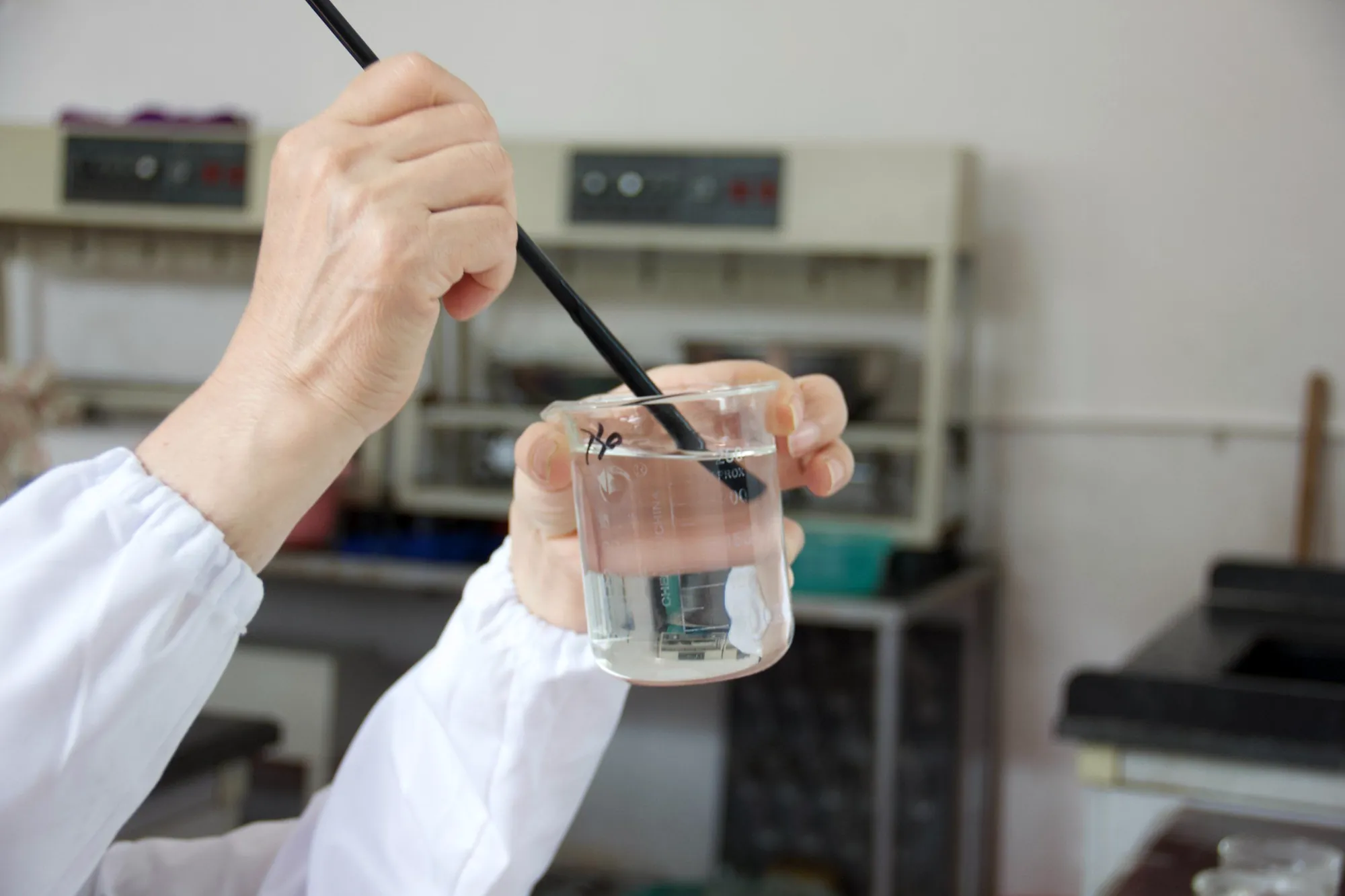
- Add the powder slowly into the vortex, or pre-blend it with dry ingredients, and stir until it is fully hydrated before you measure.
- Where you need full viscosity quickly without lumps, use surface-treated instant CMC, such as Sentai's R-series (DS ≥ 0.95).
Quick diagnosis
- Falls over days in storage, often with a sour smell: microbes. Preserve the solution and clean the tanks.
- Drops as soon as salt or hard water is added: ions. Dissolve the CMC first and choose a higher DS.
- Lower in acidic products: pH. Use an acid-stable, high-DS grade.
- Lower when hot, recovers on cooling: normal. Measure at 25 °C.
- Lower while pumping, recovers at rest: normal shear-thinning.
- Drops after the bleach goes in: oxidiser. Test compatibility before scaling up.
- Keeps rising for hours after mixing: incomplete dissolving. Stir longer or use instant CMC.
When the grade is the problem
If your conditions are tough (brine, acid, hard water or long storage), the fix is often a different grade rather than a higher dose. Send us your conditions (salt, pH, temperature and storage time) and we will recommend a Sentai grade and send a free sample: sentai-cmc.com/contact